Monday, August 05, 2013

Shark Week 3: 'The Reef' (2010)

Not to be confused with the 2006 animated movie of the same name (which also features sharks), The Reef is an Australian thriller based very loosely on a true story, about five friends whose yacht capsizes after hitting the titular object, stranding them in waters infested with great white sharks. Four of the friends decide to attempt to swim to a small island several miles away, while the fifth crew member stays behind on the overturned boat. The swimmers are constantly on edge as they look out for sharks, and although it takes until more than halfway through the movie, eventually the sharks deliver.

The Reef is a lot more serious than your average low-budget shark-attack movie, and was actually pretty well-reviewed upon its release. Writer-director Andrew Traucki does a decent job of building suspense before the shark attacks start, but once the first shark chomps into one of the characters, the movie loses momentum, since we're just sitting around waiting for the inevitable next attack. Comparisons have been drawn to Open Water, but while that movie waited until the very end to show any real violence, The Reef has several pretty gory shark-attack scenes. They may be impressively staged, but they also turn the movie from a low-key suspense story into a full-on horror movie.

The characters are thinly sketched to begin with, but the dialogue really deteriorates once the shark attacks are in full effect, and the actors (especially Zoe Naylor) really overdo it on the hysteria. The Reef is certainly a cut above the majority of shark-attack B-movies, and it compares favorably with Open Water, but those aren't the highest bars to clear.

Sunday, August 04, 2013

Shark Week 3: 'Snow Shark: Ancient Snow Beast' (2012)

There have been so many low-budget shark attack movies that it's become increasingly hard for filmmakers to find a new angle to set their story apart. That leads to things like Sharktopus and Sam Qualiana's Snow Shark: Ancient Snow Beast, which I saw at last year's PollyGrind film festival. It's your basic micro-budget horror movie, with plenty of camp, questionable acting, dicey special effects and more enthusiasm than craft. But it's occasionally entertaining thanks primarily to the amusingly moronic premise, that some sort of prehistoric shark is lurking in the snow around a small town after having been released from an underground lake.

Never mind that the snow is unlikely to be deep enough to conceal an entire shark, or that the shark lurks undetected for years despite, presumably, snow melting every spring. It's just an excuse to see a shark fin darting through the snow and to have a gruesome, bloody death every few minutes. Qualiana throws in the standard gratuitous nudity and occasional snark, but it's kind of half-hearted, and the movie has a tough time settling on a main character (since everyone keeps getting devoured by the snow shark). The extremely low budget obviously limits what Qualiana can do with the snow shark, and he wisely keeps the glimpses to the minimum required to get the premise across.

The biggest resource a movie this small-scale has is its own cleverness, but Qualiana's script isn't nearly as funny or sharp as the movie's early Jaws-parody poster. There are funny lines here and there, but the delivery is often so stilted that they fall completely flat. And Qualiana doesn't always know how to maximize his limited resources; scenes like a town-hall meeting with obvious piped-in "crowd noise" are distracting in their ineptitude. Still, fans of dumb low-budget monster movies may get a bit of entertainment out of Snow Shark, although they can probably get the same amount out of just looking at that poster.

Shark Week 3: This Time It's Personal

According to The Hollywood Reporter, shark movies are big business right now. In the five years since I first put together a week's worth of posts about shark movies in honor of Discovery Channel's mega-popular Shark Week, the market for low-budget shark-attack thrillers has greatly expanded. At the time I first came up with this idea, I figured that there wouldn't be enough interesting shark-related movies to sustain more than one week. Then two years ago, I did another week. And now there are so many shark movies being churned out that I probably could have expanded this project to an entire Shark Month.

The success of Sharknado has certainly fueled interest in cheesy shark movies, and I am here to cater to that interest. Unlike past Shark Weeks, this year's edition will feature almost exclusively recent movies, although it will of course culminate with the third Jaws movie, in keeping with my established tradition. Starting later today and for the next seven days, I'll be writing about movies that feature sharks attacking in a supermarket, a water park, the snow, a lake and the boring old ocean (I will not, however, be writing about Sharknado, because the last thing that movie needs right now is more coverage). Until then, here are the posts from the last two Shark Weeks:

Shark (1969)
She Gods of Shark Reef (1958)
Deep Blue Sea (1999)
Spring Break Shark Attack (2005)
Dark Waters (1993)
Open Water (2003)
Jaws (1975)
The Deep (1977)
Shark Attack 3: Megalodon (2002)
Tintorera: Killer Shark (1977)
Beyond the Reef (1981)
Sharktopus (2010)
The Adventures of Sharkboy and Lavagirl (2005)
Jaws 2 (1978)

Saturday, July 13, 2013

Triskaidekaphilia: 'Apollo 13' (1995)

On the 13th of each month, I write about a movie whose title contains the number 13.

Ron Howard's penchant for crowd-pleasing inspiration finds its ideal subject matter in Apollo 13, which is cheesy at times but also admirably authentic, with a commitment to historical accuracy that nicely balances the sentiment. Howard meticulously re-created details of the ill-fated 1970 Apollo 13 mission to the moon, using transcripts from the control room to construct the dialogue, and eschewing all stock footage of rocket launches in favor of constructing his own images via miniatures, CGI and practical sets. He even shot some zero-gravity scenes during actual zero-gravity training flights, which offer only 23 seconds of weightlessness each in which to capture footage.

So even though the story arc is pure Hollywood corn, and the characters come off like movie archetypes, Apollo 13 feels genuine, and that makes it easier to cheer for the three all-American astronauts when they avoid disaster and safely return home. Tom Hanks is of course perfectly cast as the honorable, friendly and ultra-competent Jim Lovell, and Bill Paxton and Kevin Bacon do well as his two crewmates. The acting in Apollo 13 is best when it's all about the characters getting things done; Ed Harris has only a few tiny moments of emotion as the no-nonsense mission control commander, but he earns his Best Supporting Actor Oscar nomination.

It's not easy to generate suspense in a movie based on a true story, when the audience already knows the outcome, but Howard manages to do just that when the Apollo 13 astronauts encounter mechanical trouble and have to turn back for home, unsure if their vessel will make it. The movie spends a little too much time on setup, and the soaring triumph at the end is a little overdone (at 140 minutes, the movie is the typical length for Oscar bait, but does feel too long), but overall it's involving, entertaining and genuinely uplifting. It's exactly the kind of slickly produced populist entertainment that Hollywood is made for.

Wednesday, July 10, 2013

'Camp'

A wholesome family dramedy full of attractive young actors, Camp seems like it would probably be more at home on ABC Family than on NBC. It also makes me miss Huge, the sadly short-lived ABC Family dramedy about a weight-loss summer camp for teens. Like Camp, Huge featured plenty of familiar elements of summer camp movies, but it also showcased the kind of characters rarely seen on TV, and it did so with nuance, compassion and impressive acting. The summer camp on Camp is more standard-issue, although it is a "family camp," meaning that kids, teens and their parents all stay together in cabins and participate in outdoor activities, which is something I'm not familiar with.

Even so, the first two episodes feature a series of stock summer-camp elements, including the talent show, the capture-the-flag game, the snooty rival camp and the summertime-only romances. The cast is appealing, led by Rachel Griffiths as the somewhat neurotic camp owner/director, who's in the process of getting a divorce. The large ensemble means that the characters are a little one-dimensional at this point, with fairly simplistic conflicts, but there are hints of complexity that could develop into something over time. For the most part, Camp is pretty basic and predictable, but if you (like me) have a soft spot for heartfelt teen/family dramas, it could be worth watching, if only to spend time with some likeable, easygoing characters.

Premieres tonight at 10 p.m. on NBC.

Monday, July 01, 2013

'Siberia'

Anyone unfamiliar with the premise of NBC's Siberia would be forgiven for turning off the first episode halfway through, mistaking it for another second-rate summer reality show, a derivative take on elements of Survivor and The Amazing Race. But Siberia isn't a second-rate reality show; it isn't a reality show at all, but rather a scripted drama presented in the style of a reality show, in which terrible things start happening on a familiar-looking survival competition series (featuring 16 contestants dropped in the titular location and forced to fend for themselves).

Those terrible things don't really show up until the end of the first episode, which is why less informed viewers might just assume that Siberia is a typical reality show. Creator Matthew Arnold, who wrote and directed the pilot, does a fantastic job of mimicking the style and tone of reality shows, from the time-lapse shots of the outdoors to the talking-head interviews to the pompous host. He copies the style so well that the episode actually gets a little tedious, especially if you know that nasty things are in store for the "contestants" (played by actors all using their real first names), and are waiting for them to show up.

It's hard to tell from this first episode how well Siberia will play out over the course of a whole season. Although its style may copy Survivor, the show that Siberia most closely resembles is ABC's The River, which was also presented like a reality show (albeit a nature-exploration show, not a survival competition). The River started with a very promising pilot before quickly painting itself into a corner, and Siberia could run into the same problems. In particular, I wonder if the reality-TV style will extend throughout the entire season; under attack from mysterious forces, will the contestants continue giving explanatory interviews, and will the cameramen continue dutifully shooting everything? For now, at least, I'm interested enough to find out.

Premieres tonight at 10 p.m. on NBC.

Thursday, June 13, 2013

Triskaidekaphilia: '13 Lead Soldiers' (1948)

On the 13th of each month, I write about a movie whose title contains the number 13.

Bulldog Drummond is a sort of second-rate Sherlock Holmes, created in 1920 by author Herman Cyril McNeile under the pen name Sapper. He starred in 17 novels from 1920-1954, as well as 26 movies from 1922-1969, played by 15 different actors. According to Wikipedia, he was an important influence on later pulp characters, as well as on James Bond, but he seems pretty much unknown today (although he may be more popular in the U.K., where the novels originated). 13 Lead Soldiers is one of the later Drummond films, and the second of two to star Tom Conway as the main character. It's a pretty rudimentary murder mystery, with a running time of just 64 minutes and a limited number of characters.

The lead soldiers of the title are antiques from the era of William the Conqueror, two of which are stolen when their owner is murdered at the beginning of the movie. Drummond, a wealthy war veteran and armchair detective, is enlisted by the owner of two more soldiers to find out who is behind the murder. The eventual reveal involves hidden treasure and secret passageways, but it's all treated as very mundane, and Drummond and his sidekick Algy Longworth (John Newland) never get particularly worked up about the crime-solving or the danger they're potentially in.

They spend far more energy competing to seduce the women they're interrogating and/or protecting, and a running subplot in the movie involves Longworth pretending to be Drummond because he believes it will help him score with the ladies. The condescending sexism pervades the movie, but apparently it's mild compared to the racist and xenophobic attitudes Drummond expressed in many of McNeile's novels (maybe that's why he's no longer appreciated). As a murder mystery, 13 Lead Soldiers is rote and mediocre, although Conway has a bit of debonair charm as Drummond (who was apparently more of a thug in other portrayals). As a forgotten piece of pop-culture history, however, it can be fascinating. (Watch the whole thing for yourself on YouTube.)

Tuesday, June 11, 2013

'Twisted'

ABC Family's original dramas seem to have two basic modes: Wholesome family-driven shows like Switched at Birth and the recent The Fosters, and superficially "dark" teen dramas like Pretty Little Liars and The Lying Game. Twisted falls in the latter category, with its ominous murder mystery and pouty, tortured teens. It's all completely sanitized and safe, despite the dead teenage girl who shows up in the premiere (and whose murder presumably forms the main plot thread of the season). There's another offscreen death at the beginning of the episode, as 11-year-old Danny (Avan Jogia) kills his aunt for mysterious reasons. Five years later, he's out of prison and attempting to restart his life by returning to his close-knit hometown and attending high school with his former best friends Jo (Maddie Hasson) and Lacey (Kylie Bunbury).

Danny looks way too much like a model to have spent the past five years in juvenile detention, and in general the show's "menace" is pretty laughable. The rest of it is generic teen-soap nonsense, enlivened slightly by Hasson's appealing performance as the too-pretty high school "outcast" and Denise Richards' basically reprising her role from the modern classic Wild Things as Danny's bitchy, self-centered mother. The banter is half-baked (although the show does its best to coin "socio" as a new slang term, referring to Danny's possible sociopathic nature) and the characters are mostly one-dimensional. Fans of Pretty Little Liars and The Lying Game may find some entertainment here, but all I really want from ABC Family is another season of Bunheads.

Premieres tonight at 9 p.m. on ABC Family.

Thursday, June 06, 2013

'The Hero'

I like The Rock, but man is he phoning it in as the host of TNT's muddled Survivor/Fear Factor/The Mole hybrid The Hero. About half of his hosting segments just involve him talking in front of a green-screened backdrop in the same style as the contestant confessionals, and he's not even present for all of the big physical challenges in the first episode. He may be one of the show's producers, but the whole thing seems sort of beneath him, since he's a legitimate movie star at this point. He's also pretty much the only entertaining aspect of this show, which has a weak premise and a cast full of reality-TV stereotypes.

I'm pretty sure that signing up for a TNT reality show automatically disqualifies a person from being a hero, but the idea here is that the nine contestants are competing for some nebulous title of "hero," which is defined partly by completing intense physical challenges that involve facing fears, partly by resisting and/or giving in to temptation when faced with offers of compensation in exchange for screwing over fellow contestants, and partly by some undefinable quality that will be judged by the audience, who ultimately get to vote for the winner. In practice this means some standard-issue reality-competition set pieces (rappelling off the side of a building, crawling through a maze in the dark) and even more standard-issue reality-TV bickering, which is about as far from heroic as it gets.

The Rock does his best to play up the idea that this all has something to do with heroism, and his most amusing habit is constantly addressing the audience as "America" ("Hola, America" is the first line of the show). Despite higher production values than some cable reality shows, and impressive-looking locations in Panama, The Hero is not nearly as exciting as The Rock pretends to think it is.

Premieres tonight at 8 p.m. on TNT.

Wednesday, May 29, 2013

Bette Davis Month Bonus: 'The Cabin in the Cotton' (1932)

The Cabin in the Cotton opens with an overwrought disclaimer describing the historical conflict between plantation owners and sharecroppers in the American South, and assuring moviegoers that the producers of the film have no desire to take sides. That dull evenhandedness infuses the rest of the film, which works hard to portray the disagreements between the rich landlords and their indentured workers as something to be solved with minor compromise, rather than as a system built on inequality and prejudice.

Not that the filmmakers have an obligation to present a detailed political critique within the context of what is essentially a B-level melodrama, but the movie spends so much time foregrounding the social commentary that it would be nice if it were less laughable. A big part of the problem is leading man Richard Barthelmess, a silent-era star who didn't have much of a career once sound came in. He looks sallow and lifeless as sharecropper's son Marvin Blake, who ends up caught between working for the rich plantation owner and helping his friends and relatives who work the fields. There's a weird undercurrent of anti-intellectualism to the story as well, since Marvin's ambitions to succeed in school are what take him away from his roots into the corrupt world of the upper class, and he's relentlessly mocked for his book-learnin' by the people he grew up with.

He's also torn between the wholesome but boring girl next door (literally) and Madge, the sexually aggressive daughter of the plantation owner. Naturally, Bette Davis' performance as Madge is the best thing in the movie, and she's excellent at playing the sultry, snobby rich bitch. She shamelessly throws herself at Marvin, using her feminine wiles to manipulate him into betraying his class, and then snubbing him when he speaks up in favor of the poor. Davis' performance is playful and seductive, and features one of her all-time greatest (and most quoted) lines: "I'd like to kiss you, but I just washed my hair." As great as Davis is, however, she and Barthelmess have no chemistry, since he plays his entire part like he's suffering from mild indigestion (including his big speech at the end). Still, the movie is a great example of how Davis could shine in even the dreariest material.

Monday, May 13, 2013

Triskaidekaphilia: 'Thirteen Ghosts' (2001)

On the 13th of each month, I write about a movie whose title contains the number 13.

The 2001 remake of William Castle's 1960 schlock-horror classic 13 Ghosts (which I wrote about a year ago) was part of a short-lived initiative to revive Castle properties as modern horror B-movies (it followed a 1999 remake of House on Haunted Hill), but it takes only the barest elements from the original movie, changing a hokey family ghost story into a loud, R-rated killing spree. Plot-wise, there's still a down-on-their-luck family inheriting a creepy house from their deceased uncle, and the house is still filled with the titular ghosts (only 12, as the 13th is slated to be one of the family members), but the approach is completely different.

While the ghosts in the original turned out to be sort of harmless, here they are bloodthirsty and deadly, and once the family members end up inside the house, they're almost immediately hunted by the murderous apparitions. The house itself is the movie's most impressive element; it's a marvel of production design, a shifting puzzle box of glass and metal gears that one character reveals is "a machine designed by the devil and powered by the dead." Nearly the entire movie takes place in this one location, over the course of a single night, and director Steve Beck (a special-effects veteran making his directorial debut) creates a claustrophobic atmosphere as the characters run back and forth between corridors and locked rooms.

The characters themselves, however, are pretty one-dimensional, and the plot is full of so much mystical mumbo jumbo that it ends up being total nonsense. The ghosts, although certainly gorier than those in the original, aren't very scary, and the incoherent plotting takes away much of the potential suspense. The cast is a mix of talented actors slumming for a paycheck (Tony Shalhoub, F. Murray Abraham, Embeth Davidtz) and C-level performers you'd expect to see in a movie like this (Matthew Lillard, Shannon Elizabeth, rapper Rah Digga), but everyone ends up on the same mediocre level.

They're really just pieces to move around the elaborate set and react to the less impressive special effects. The filmmakers recycle one of Castle's gimmicks by updating the idea of special glasses being used to see the ghosts, but since the movie wasn't ever shown in 3D, the point is kind of lost. As schlocky as Castle's work was, at least it had a personal touch; this version is merely a product trading on vague name recognition.

Saturday, April 13, 2013

Triskaidekaphilia: 'Lucky 13' (2005)

On the 13th of each month, I write about a movie whose title contains the number 13.
 
Shot somewhere around 1999 but not released until 2005, Lucky 13 probably only found distribution after such a long time thanks to co-star Lauren Graham's Gilmore Girls fame. It certainly doesn't deserve attention for anything else -- not its lame, half-assed story, weak dialogue, annoying characters or unfunny jokes. And certainly not for charisma-free leading man Brad Hunt, whose performance is so smarmy that I initially assumed he must be the writer and director as well, putting together a vanity project about how attractive and charming he is.

But no, Hunt is just the crappy actor hired by actual director Chris Hall to play 20-something loser Zach, who's spent his entire life pining away for his neighbor Abbey (Graham). When Abbey announces she is moving to New York City to become an artist, Zach finally asks her out on a date, and he has just a few days to make himself the perfect boyfriend material for Abbey. Thus he decides to revisit all 12 of his past girlfriends to learn why he could never hold onto a relationship.

This is a pretty standard contrived rom-com setup, but Hall and his co-writers completely screw it up with terrible pacing, lame jokes and barely sketched characters, including all of Zach's exes, many of whom barely even get any lines. Only a couple of his exes actually serve their ostensible plot purpose and give him some advice; otherwise they just show up for bad jokes or as background filler. I'm not entirely sure there are even 12 of them.

In addition to Graham, Lucky 13 is full of soon-to-be-famous faces, including Kaley Cuoco, Jenna Fischer, Taryn Manning, Ever Carradine, Pamela Adlon and Sasha Alexander (also a producer on this mess). There's also Harland Williams in a surprisingly subdued performance as Zach's goofy best friend, plus X's John Doe and That '70s Show's Debra Jo Rupp as his parents. The movie isn't worthy of any of their talents.

Friday, April 05, 2013

Bette Davis Month Bonus: 'The Golden Arrow' (1936)

Alfred E. Green directed Bette Davis in a number of her early films, including the 1932 hidden gem The Rich Are Always With Us. Green's The Golden Arrow isn't as entertaining as The Rich Are Always With Us, but it has a similar cheeky tone and playful attitude toward the quirks of the idle rich. Davis stars as what at first appears to be the heiress to a cosmetics fortune, a spoiled young woman who spends all her time lounging about on her yacht off the coast of Florida and entertaining various suitors. But Davis' Daisy is actually an actress hired to pretend to be a cosmetics heiress, in order to drum up publicity for the company.

This particular bit of information doesn't come to light until about halfway through the movie, after which Daisy has already proposed marriage to humble newspaper reporter Johnny Jones (perpetual Davis co-star George Brent), as a mutual business arrangement so he has leisure time to write his novel and she can fend off the advances of her persistent suitors. Except he still thinks she's a real heiress, and her bosses at the cosmetics company don't want her getting married at all. Got that? It's a convoluted setup that gets even more ridiculous as the movie goes on, but Green plays it all as light farce, and Davis has loads of fun as the street-smart dame who's infiltrated high society.

The ending involves a set piece built around some uncomfortable domestic violence humor, and the story kind of runs out of steam by that point anyway. But Davis and Brent have decent chemistry (although Brent is, as always, sort of bland by comparison), and the bits of sly commentary about the indulgences of the rich are entertaining and sharply delivered. It's rare to find a gem among these generic programmers that Davis made early in her career, so even though The Golden Arrow has its flaws, it still qualifies as a pleasant surprise.

Monday, April 01, 2013

White Elephant Blogathon: 'The Beast of Yucca Flats' (1961)

Sadly, last year I missed out on the White Elephant Blogathon, in which bloggers submit movie suggestions to a pool and then write about a randomly chosen selection from another blogger, but I'm back on board this year. The first year I participated, I got something boring (Dr. Dolittle: Million Dollar Mutts), and the second year, I got something terrible (Scorpion Thunderbolt), and this year I got a movie that's both boring and terrible, Coleman Francis' The Beast of Yucca Flats.

Although Beast is probably best known for its appearance in an episode of Mystery Science Theater 3000, I did not cheat -- I watched the original film without any comedic commentary, although I did check out some MST3K clips online. And boy is this a movie that needs comedic commentary to liven things up. It's only 54 minutes long, but it feels like a lifetime, with maybe 10 minutes of plot crammed into endless scenes of cars driving and parking (seems Francis must have been a big influence on Birdemic's James Nguyen), all narrated semi-coherently by Francis himself, since there was no sound recorded during production.

That means that either Francis is narrating in his rambling, ponderous style (sometimes filling in plot and character details, sometimes waxing poetic about nuclear armageddon), or he's throwing in awkwardly dubbed dialogue that can only be delivered when characters are offscreen or have their faces obscured in some way (since none of the words match up to the movement of the actors' mouths). It's possible to achieve a sort of otherworldly effect this way, and the movie's opening scene (which seems to have no connection to the rest of the story), in which a nearly naked woman is strangled by an unseen brute as a clock ticks loudly, is actually pretty creepy.

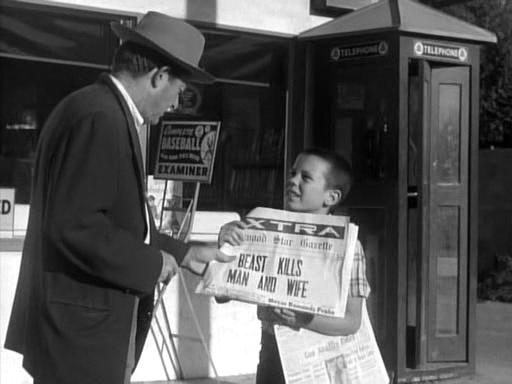
But the rest of the movie is just moronic, with a Soviet scientist played by Ed Wood favorite Tor Johnson getting caught up in a nuclear blast and transformed into the beast of the title. Mostly that means he lumbers around the sparse landscape, occasionally listlessly choking some anonymous passerby. Francis fails at creating suspense or even shocks; Johnson looks less like a beast and more like a guy with a bad sunburn. He clumsily stalks incompetent cops and an annoying family on vacation, but none of the performances have enough energy to make the threat seem urgent or even particularly dangerous. When the beast is defeated, it's the final anticlimax in a movie that's just one long disappointment.

Kenji Fujishima wrote a fascinating post on my pick, Cannibal Women in the Avocado Jungle of Death, which I definitely need to revisit.

Wednesday, March 13, 2013

Triskaidekaphilia: 'Last Stop on 13th Street' (1978)

On the 13th of each month, I write about a movie whose title contains the number 13.

Like 13teen, Last Stop on 13th Street is a cheapo B-movie slapped with a new title featuring the number 13 to make it sound more ominous. To be fair, it was originally released as Alien Zone, which is a far more nonsensical title, since there are no aliens anywhere in the movie (it's also known in some releases as The House of the Dead, which is by far the most accurate title), and there is at least a street (never indicated as 13th Street, though), at which one of the movie's main characters makes a last stop. But the title really has nothing to do with the plot, which features a philandering salesman making a wrong turn and ending up taken in by a charmingly sinister mortician (Ivor Francis, giving the movie's most effective performance).

The movie then turns into a sort of second-rate Twilight Zone or Tales From the Crypt, as the mortician takes the salesman through his parlor, opening a series of four coffins and telling stories about the inhabitants of each. The stories are pretty half-baked: A shrill teacher is murdered by some sort of child-monsters; a creepy guy films himself seducing/murdering women (featuring the least convincing onscreen strangulation I've ever seen), then gets caught; two master detectives entertain a deadly rivalry; and a callous businessman is tortured by unseen forces.

The detective story at least has a pair of fun performances and a satisfying (if painfully predictable) ending, and I could see it actually being a lesser episode of one of the shows the movie is copying. The rest of the stories are poorly paced and completely ineffective at creating suspense, and the framing sequence ends with the obvious twist that the adulterer is now the mortician's latest victim. The version of the movie I saw via Amazon Instant (obviously ripped from an old VHS tape, complete with tracking problems and murky, degraded image) is only 77 minutes long, and IMDb claims that there's a 100-minute cut out there somewhere, which might alleviate some of the choppiness, but is unlikely to improve the tedious plotting, lackluster acting and ugly visuals.

Friday, February 22, 2013

'Out There'

Virtually no one watched last year's underrated (if uneven) FX animated series Unsupervised, so people probably won't notice how much it has in common with the new IFC animated series Out There. Although both shows have the familiar structure of dumb, vulgar animated comedies, both shows soon reveal themselves as something more thoughtful and true, more interested in the painful peculiarities of being a teen outcast than in crafting lame gross-out jokes.

Like Unsupervised, Out There focuses on a pair of teen misfits who team up against the world, two best friends who bond together almost out of desperation. Out There's Chad and Chris are more typical sullen teenage outcasts (as opposed to the relentlessly positive protagonists of Unsupervised), with crushes on girls and dreams of running away and frustrating parents who don't understand them. The actual plotting of the show isn't particularly groundbreaking, but creator Ryan Quincy has a distinctive personal perspective (much of the show is autobiographical) that shines through, especially in his narration and voicing of main character Chad.

Also like Unsupervised, Out There isn't actually all that funny, but while it does have jokes, it's also built around a sense of melancholy that pervades even the silliest moments. Quincy's narration has a literary quality that feels almost like a reading of a decent short story or personal essay, and there's a real sadness to the characters' efforts to look cool or escape their boring small town or impress a pretty girl. Visually, the characters look like sort of animal/human hybrids (Chad and his brother and father resemble relatives of Cousin Itt), but their behavior is completely grounded and realistic. Out There isn't brilliant -- it has plenty of clumsy moments and jokes that fall flat -- but it has a unique voice that deserves to find more of an audience than Unsupervised did.

Premieres tonight at 10:30 on IFC.

Thursday, February 21, 2013

'Upload With Shaquille O'Neal'

I don't follow sports at all, but I find Shaquille O'Neal kind of fascinating because he's clearly so desperate to be an entertainer. While he was in the NBA, he took time out to star in terrible movies (Steel, Kazaam), record terrible albums (Shaq Diesel, Shaq Fu) and host terrible reality shows (Shaq's Big Challenge, Shaq Vs.). Now that he's retired from basketball, he's able to devote all of his time to pursuing his misguided goal of becoming America's most beloved seven-foot-tall TV personality.

The latest chapter in this ongoing effort is Upload With Shaquille O'Neal, a Tru TV show that's basically Shaq hosting America's Funniest Home Videos. Although the format is similar to Tosh.0 or MTV's Ridiculousness in that it features videos culled from the internet, the videos themselves are the exact same kind of thing you'd see on AFV, primarily focused on people falling down and/or hurting themselves comedically. It's no surprise, since AFV executive producer Vin di Bona is also behind Upload, and the format, with its family-friendly humor, "clip of the week" and slick announcer (I swear it's the same guy), is basically a copy of AFV.

As for Shaq himself, he's propped up by comedians Godfrey and Gary Owen as co-hosts, so he mostly sits there and laughs at the clips, and occasionally reads some corny jokes. He also stars in some lame sketches in between videos, which are about as clever as, well, Bob Saget's voiceovers on AFV. This is the kind of show you could watch with your entire family without worrying that anyone will be offended (or more than mildly entertained), and like AFV, it could run for years without anyone noticing. Wearing a sweater vest and delivering puns, Shaq has successfully transformed himself into Bob Saget circa 1992, and you get the impression he couldn't be happier about it.

Premieres tonight at 10:30 on Tru TV.

Tuesday, February 19, 2013

'Cult'

In the last few weeks, we've had one terrible new network drama (The Following) about an insidious cult of serial killers, and another terrible new network drama (Zero Hour) about a convoluted, wide-ranging conspiracy. The CW's new drama Cult combines both of these misguided concepts into one series, and then adds in an evil television show for good measure. Creator Rockne S. O'Bannon (Farscape) has a decent reputation in genre TV, but the first episode of Cult is an incoherent mess, as laughably confused as Zero Hour and nearly as unpleasantly grim as The Following.

The idea is that a creepy TV show (which airs on The CW, of course) is somehow inspiring its most rabid fans to commit violent acts as directed by the main villain on the show. Or at least that's what seems to be happening, since the pilot is all about vague ominous hints and very few concrete details about what's going on. A disgraced reporter (Matthew Davis) whose brother has gone missing after investigating the show teams up with one of the show's researchers (Jessica Lucas) to dig into the mysterious activities of the fans, and they discover ... something sinister, although it's not exactly clear what that is.

Cult fails pretty miserably at creating a sense of danger and menace, exemplified by the "creepy" catch phrase that victims both on the show and in the real world utter just before dying ("Well hey, these things just snap right off"). All of the suspense is hilariously overwrought and completely unconvincing, and while there's a hint of campy satire in the portrayal of the network executive trying to give the show's reclusive-genius creator notes, Cult doesn't really have a coherent perspective on TV fandom or serialized genre entertainment. You'd think a genre TV show looking to engender a cult following would be good at representing a genre TV show with a cult following, but the show-within-the-show rings false. Thus we're left with the dour, incoherent mystery, which offers no enticement to tune in again. It's doubtful Cult will inspire its fans to do anything more drastic than change the channel.

Premieres tonight at 9 p.m. on The CW.

Wednesday, February 13, 2013

Triskaidekaphilia: '1313: Actor Slash Model' (2011)

On the 13th of each month, I write about a movie whose title contains the number 13.
 
According to Wikipedia, Z-grade filmmaker David DeCoteau has made more than 90 feature films in the past 25 years, and his latest assembly-line brand is the 1313 series, quickie straight-to-video "thrillers" marketed to a gay male audience despite containing no actual gay content whatsoever. Instead, these movies, all of which run less than 80 minutes and many of which were apparently shot in the same prefab mansion, feature shirtless young hunks wandering around aimlessly, working out, swimming and occasionally stumbling across something resembling a plot. There's no sex or even kissing, and no nudity beyond the kind of shirtlessness you could find in an Abercrombie & Fitch catalog.

Despite my dedication to this ongoing project, I have no intention of watching more than one of these 1313 movies, which by all accounts are interchangeable. So I picked what may be the first one (it's hard to tell, since DeCoteau churns them out so quickly), Actor Slash Model, which is at least a somewhat clever title for the story of a disgruntled actor murdering the pretty-boy models who keep getting the parts he wants. But as indicated above, the movie spends maybe 10-15 minutes on the actual plot, which boils down to the killer wandering around the empty mansion and killing vapid hunks one by one. DeCoteau is so focused on beefcake that he doesn't even bother delivering any thrills; the killer carries around what looks like a small kitchen knife, and each murder scene cuts away before we can see the actual stabbing. The knife is always clean afterward; it's as if the production didn't even have the budget for some fake blood and a prop knife.

DeCoteau's idea of suspense is to blare loud, "ominous" music over endless scenes of actors slowly walking through the empty house, calling out "Hello?" over and over again (these scenes go on for literally three or four minutes at a time). The actors are good-looking in a generic way, but, perhaps in an inadvertent nod to the plot, give terrible performances, and some can't even keep the other character names straight between scenes (DeCoteau's other "suspense" technique of replaying previous dialogue over the lengthy walking scenes ends up repeating one particularly egregious name mix-up over and over again).

I guess these movies must be some sort of success with gay viewers, because DeCoteau has made at least 14 of them (again, according to Wikipedia), but to me they seem insulting and condescending. DeCoteau panders to his audience by showcasing shirtless hunks, but then backs off from any themes or dialogue or plot points that might be relevant to the people he's supposedly trying to reach. I'm sure he'd defend his work as harmless fluff, but it's really just tedious nonsense, and anyone looking to ogle shirtless dudes can find numerous better ways to do so.

Monday, February 04, 2013

'Monday Mornings'

I don't trust David E. Kelley. It seems that no matter how his shows start out, they eventually devolve into the same Kelley formula of absurd twists, overly quirky characters and heavy-handed speechifying. His new medical drama Monday Mornings seems pretty subdued in its first three episodes, at least compared to the later years of shows like Ally McBeal and Boston Legal (the two Kelley shows I followed most closely), but it definitely has some of the Kelley warning signs. There are little character quirks that start to become more prominent (one doctor has a habit of swaying back and forth on his squeaky sneakers when nervous, a tic that director Bill D'Elia, a longtime Kelley collaborator, always shoots in close-up), and there is plenty of melodramatic grandstanding, which is pretty much built into the show's concept.

The title refers to meetings/inquisitions held by the chief of staff at the show's fictional Chelsea General Hospital in Portland, Oregon, at which he dresses down doctors for their various failings during the previous week. This gives Alfred Molina, as the chief of staff, the chance to deliver at least one self-righteous monologue per episode, and the actors playing the other doctors rotate their own impassioned speeches depending on the storyline. There's a lot of overwrought emoting from patients and doctors, which D'Elia highlights with showy camerawork, and the interpersonal drama is pretty underdeveloped.

When the show isn't displaying Kelley's worst tendencies, it's a generic medical drama, with life-or-death cases, heartbreaking surgical complications and miracle diagnoses. I have a pretty low tolerance for that sort of thing, but fans of medical dramas may find something appealing in Mornings' various cases-of-the-week. Kelley has also assembled an impressive cast, including Molina, Ving Rhames, Jennifer Finnigan and Jamie Bamber, and there's an admirable diversity in the casting. But that can't make up for the problems with the writing and directing, and Kelley is probably just going to squander the show's strengths by the end of the season anyway.

Premieres tonight at 10 p.m. on TNT.