On the 13th of each month, I write about a movie whose title contains the number 13.
Japanese animation is one of my serious movie blind spots; I've seen only a handful of movies (three, I think, counting this one), and I find much of the style off-putting, although I realize it's unfair to generalize an entire varied genre that way. The point being, I may not really know what I'm talking about here, and seasoned anime fans could probably offer up better context for The Professional: Golgo 13, the first animated feature based on popular, long-running Japanese comics character Golgo 13 (aka Duke Togo).
Golgo 13 comics have been published continuously since 1969, and the character was adapted into two live-action movies (in 1973 and 1977) before this, as well as a later direct-to-video animated special and an animated series in 2008. I remember first hearing about the character thanks to the 1988 Golgo 13 video game for the original NES, but I don't think I knew much about him. Not that there's really that much to know: Golgo 13 is a mysterious assassin-for-hire whose nationality, age and real name are unknown. At least in this movie, he's essentially invincible and infallible, never missing his targets and never getting killed or more than lightly injured, despite being shot at by dozens of trained killers, caught in explosions and thrown from moving vehicles.
He also rarely speaks and never changes his grim facial expression, even while being surrounded by attackers or having sex with beautiful women (possibly the funniest moment in the movie occurs when some random hottie is writhing in ecstasy on top of Duke, and he just lies there, completely stoic). It all makes him into a completely uninteresting character, so the movie has to rely on the various villains, sex partners and hangers-on for its meager character development. The story is episodic in the movie's first half, but eventually ties together when Duke finds himself on the run from a cabal of CIA, FBI and military forces hired by an ultra-wealthy industrialist to take him out. Since he might as well be a superhero, things don't really go as planned for the bad guys.
Golgo 13 is full of anime's visual trademarks, including speed lines, abstract action sequences, split screens and static backgrounds. It also has one of the earliest uses of computer-generated animation, which as expected looks awkward and stiff. To me, the movie is hokey and laughable (the horrendous smooth-jazz score is particularly egregious), but some fans at least seem to regard it as an anime classic. With its insanely over-the-top violence and sex, overwrought dialogue and hammy acting (from the drawings as well as the voices), it's really just another artifact of '80s movie excess.
Sunday, January 13, 2013
Monday, January 07, 2013
'Deception'
The obvious point of comparison for NBC's new drama Deception is ABC's Revenge: Both involve attractive young women with hidden agendas infiltrating wealthy, corrupt families in the Hamptons. But while Revenge is an unabashed soap opera, Deception seems, at least from the first episode, to be going for more of a serious crime-drama feel. With its hints of a grand conspiracy, it's really no less ludicrous than Revenge, but the creators are playing things straight for now.
Straight also means mostly dull in the first episode, which introduces police detective Joanna Locasto (Meagan Good), the daughter of the former housekeeper for the ultra-rich Bowers family. When daughter Vivian Bowers, Joanna's childhood best friend, is found dead of what appears to be a drug overdose (but is suspected of being murder), Joanna gets sent undercover as herself, to infiltrate the Bowers family and discover the truth about Vivian.
There are plenty of juicy plot elements just in the first episode (the Bowers family pharmaceutical company may be releasing a deadly drug! Joanna used to hook up with Vivian's brother when they were teens! Vivian's older brother was once accused of rape and murder!), including a big plot twist at the end, but it's all played so grim and somber that it doesn't really get a chance to be much fun. The hints of a conspiracy around the family pharmaceutical company seem to indicate a rather uninteresting storyline, and the relationship drama (including Joanna's on-again, off-again romance with her FBI handler) is similarly lifeless.
Good is an appealing lead, and Victor Garber does typically solid work as the Bowers family patriarch. Tate Donovan's performance as Vivian's maybe-rapist brother connects Deception to Damages, another soapy crime drama that took its outlandish twists way too seriously. Despite the fairly novel (for TV) set-up of an African-American lead in a show with a white supporting cast, the first episode doesn't have a single thing to say about race (or class, for that matter). The pilot makes Deception seem like it's going to end up being the world's longest Law & Order episode, and that's not something I'm particularly interested in sticking around for.
Premieres tonight at 10 p.m. on NBC.
Wednesday, January 02, 2013
My top non-2012 movies of 2012
At the end of each of the last few years, I've posted a list of my favorite movies from other years that I saw for the first time during that year (here are my lists from 2011, 2010, 2009 and 2008), but for various reasons (mostly an increase in non-movie-related writing assignments), I didn't see as many older movies this year as I have in recent years. So rather than fill out a list with movies I wasn't that enthused about, here instead is a shortened list of my top six non-2012 movies that I saw for the first time in 2012.
1. Bonjour Tristesse (Otto Preminger, 1958) Thank goodness for the TCM Classic Film Festival, at which I saw three of the movies on this list, including this wonderful unheralded masterpiece from Preminger, a filmmaker with a long, eclectic career spanning thrillers (Laura, Anatomy of a Murder), musicals (Carmen Jones, Porgy and Bess), romances (Forever Amber, Daisy Kenyon) and social-issue dramas (The Man With the Golden Arm, Advise & Consent). Bonjour Tristesse is none of those, although it is at times thrilling, romantic and socially relevant, all while maintaining a completely unique and surprising tone. Jean Seberg is delightful as a flighty young woman who both wants to rebel against her playboy father (David Niven) and keep him all to herself. Preminger mixes a breezy, adventurous sensibility with a core of real heartbreak and loss.
2. Cry Danger (Robert Parrish, 1951) Another discovery from TCM Fest, this clever, well-written noir both embraces and subverts familiar genre elements, including the femme fatale and the convoluted double-crossing. A passion project for star Dick Powell, it showcases him at his best playing a sardonic criminal looking to recover some money owed to him, a seemingly simple task which naturally spirals out of control. Rhonda Fleming is also very entertaining as the love interest/obstacle, and the movie skillfully integrates dry wit with genuine menace. Read more in my review.
3. Girl Shy (Fred C. Newmeyer and Sam Taylor, 1924) One more selection from TCM Fest, this one a silent comedy starring Harold Lloyd, who often ends up being an afterthought compared to Charlie Chaplin and Buster Keaton. But to be honest I enjoyed this more than any Keaton or Chaplin movie I've seen (which is admittedly not that many), finding it creative and heartfelt and genuinely funny in a way that those other movies just haven't been for me. Lloyd stages some amazing set pieces (including a mind-boggling car chase), but he also does a great job of developing a believable tragic character within the context of the over-the-top comedy.
4. Rampart (Oren Moverman, 2011) Every year I end up spending a bunch of time in January and February catching up on some notable end-of-year releases from the previous year, and this is one acclaimed 2011 movie that I didn't end up seeing until it opened in Vegas in March. The film itself can be a little unfocused, but Woody Harrelson's performance as a conflicted corrupt cop is excellent, and I like how Moverman is more concerned with character study than with procedural details, despite the story's basis in a real-life scandal. Read more in my review.
5. Ben-Hur (William Wyler, 1959) I appreciate when theater chains and companies like Fathom Events hold special screenings of older films on big screens, and I always mean to attend more of them (they often fall on evenings when I have to attend press screenings). This is one of the few I managed to make it to this year, and seeing this movie in a theater (actually on the oversized XD screen at the Cinemark South Point here in Vegas) was a really impressive experience. This is pretty much the definition of epic filmmaking, and Wyler conveys the scope and grandeur of the story in a way that I'm not sure anyone can anymore. Even with all the advances in modern special effects, the chariot-race sequence in this film is still one of the most astonishing things I've ever seen onscreen. The sheer scale of the movie can get exhausting, and I found the insistent, overt preaching at the end a little frustrating, but overall this is a pretty amazing cinematic achievement.
6. The Lady Eve (Preston Sturges, 1941) This is the third time I've had a Sturges movie on this list (I listed The Palm Beach Story in 2010 and Sullivan's Travels in 2008), and I'm repeatedly amazed at his cleverness and creativity, especially within the confines of Hollywood studio movies in the 1940s. The plot twists in the movie, featuring Barbara Stanwyck as a con artist with whom Henry Fonda falls repeatedly in love, are completely outlandish, but Sturges commits to them in such a wholehearted way that they feel almost natural. That's his consistent skill: Telling stories that are completely unpredictable and surprising, yet hold together remarkably from moment to moment. The Lady Eve is easily up there with his best work.
Honorable mention to two movies that I saw this year for the second time but enjoyed much more than I had initially: Josie and the Pussycats (Harry Elfont and Deborah Kaplan, 2001), which is even more incisive and amusing in its music-biz satire now than it was a decade ago; and The Exorcist (William Friedkin, 1973), which probably suffered from heightened expectations the first time I saw it, but which really impressed me years later (on the big screen, like Ben-Hur), with the intensity of its emotional drama and the seriousness of its religious inquiry (plus Linda Blair's amazing performance).
Monday, December 31, 2012
My top 10 comic books of 2012
I haven't written much about comics here lately, mainly because I tend to be behind on my reading and anything I have to say would end up not being very timely. But I'm still an avid comics reader, and this year I've also been an occasional contributor to Comic Book Resources, including writing a few items for their list of the top 100 comics of 2012. Since my pieces are scattered throughout the list, and some weren't used, I thought I'd reprint them all here, in order. So here are my top 10 comic book series of 2012.
1. The Unwritten (Mike Carey/Peter Gross; DC/Vertigo) Even after nearly 50 issues, Carey and Gross can still find new avenues to explore in their examination of the way storytelling influences every aspect of society, and they're constantly pushing their own storytelling abilities along the way. As emotionally affecting as it is intellectually challenging.
2. Saga (Brian K. Vaughan/Fiona Staples; Image) Totally upending preconceptions about epic sci-fi,Vaughan and Staples bring snappy, postmodern dialogue and self-aware characters into a worlds-spanning space opera, creating something that feels wonderfully new yet honors all of its various influences.
3. Fatale (Ed Brubaker/Sean Phillips; Image) Pretty much everything Brubaker and Phillips do well (noir-style visuals, hard-boiled dialogue, ingenious plot twists, seductive women, compromised men, mixing the supernatural with the mundane) all combined into one fascinating series.
4. Prophet (Brandon Graham/Simon Roy, Giannis Milonogiannis & Farel Dalrymple; Image) I have to admit that I only understand about a third of what goes on in this bizarre, endlessly creative series, but I love every bit of it. Graham has taken Rob Liefeld's muscled-up creation and made him into a melancholy avatar of sci-fi craziness.
5. Irredeemable/Incorruptible (Mark Waid/Peter Krause, Diego Barreto & Damian Couceiro; Boom!) Waid wrapped up his linked series about a superhero gone bad and a supervillian gone good with impeccable skill, bringing in serious themes about the nature of responsibility and the power of childhood influences while also telling a fun, action-packed superhero story.
6. Alabaster: Wolves (Caitlin R. Kiernan/Steve Lieber; Dark Horse) Kiernan's supernatural Southern gothic is a showcase for her twisted take on religion, with demon-hunter Dancy Flammarion representing the more unforgiving side of God's plan.
7. Chew (John Layman/Rob Guillory; Image) Consistently weird, inventive, hilarious, unpredictable and surprisingly deep for a comic about a guy who can see an object's past by chowing down on it.
8. The New Deadwardians (Dan Abnett/I.N.J. Culbard; DC/Vertigo) Did I know I wanted to read a series that crossed The Walking Dead with Downton Abbey? No, but apparently it was exactly the right combination.
9. Revival (Tim Seeley/Mike Norton; Image) Seeley and Norton manage to come up with an intriguing twist on the tired zombie formula, mixing horrific acts with solid family drama.
10. Animal Man (Jeff Lemire/Travel Foreman & Steve Pugh, DC) In the midst of the New 52, Lemire has created a haunting horror series about the lengths one man will go to protect his family.
Thursday, December 13, 2012
Triskaidekaphilia: 'Assault on Precinct 13' (2005)
On the 13th of each month, I write about a movie whose title contains the number 13.
A year ago, I wrote about John Carpenter's lean 1976 thriller Assault on Precinct 13, which I found even more impressive on second viewing. The 2005 remake, directed by French filmmaker Jean-Francois Richet, is not nearly as good, losing most of what made Carpenter's film successful and turning the story into a mundane crime thriller that makes little sense. A big part of the appeal of Carpenter's film is its simplicity, and Richet and screenwriter James DeMonaco lose that right away, spending the first several minutes of the movie establishing a tragic back story for main character Sgt. Jake Roenick (Ethan Hawke). Even worse, the faceless, almost zombie-like gang members who besieged the nearly abandoned police precinct in the original film have turned into talkative villains with convoluted motivations, which become less and less believable the more we learn about them.
In an interview earlier this year, Hawke said that he "just looked depressed" throughout this movie, and indeed the entire cast seems pretty dispirited, although Laurence Fishburne is good at delivering silky menace as crime boss Marion Bishop, whose presence in a holding cell in the broken-down old police station is the catalyst behind the siege. As Roenick, Hawke does project an air of world-weariness, but the character's angst doesn't really amount to much. The cast also includes Maria Bello, Brian Dennehy, Gabriel Byrne and John Leguizamo, but they're all playing stock types, from the mustache-twirling corrupt cop to the aging officer just on the verge of retirement.
Richet creates some moderately suspenseful moments, but the story drags on for way too long, especially when the entire climax takes place outside the precinct and involves a lame and obvious plot twist with one of the main characters. There was one development in the movie that took me by surprise, when a character who seemed destined for a happy ending was unceremoniously killed off, but there was nothing as brutal or shocking as the murder of the young girl in Carpenter's film. In a way, the obligation to use Carpenter's premise hampers the movie, since the police-corruption storyline fits awkwardly with the siege of a rundown old precinct. Maybe it would've been better to just make one without the other.
Tuesday, November 13, 2012
Triskaidekaphilia: '13teen' (2005)
On the 13th of each month, I write about a movie whose title contains the number 13.
The number 13 is an easy thing to throw into the title of your shitty straight-to-video horror movie in order to make it sound more ominous, and that seems to be exactly what happened with 13teen, whose original (and less scary) title was For Sale by Owner. Of course, the new title makes no sense (how do you pronounce that -- "thirteen teen"?), but it at least looks cool on the DVD box. The movie itself is not nearly as badass, however. It's a slow, tedious and poorly acted thriller with dialogue that sounds like it was written by an alien who doesn't quite understand human interaction.
The original title refers to the fact that the house where all the action takes place (even exterior shots are so close on the house that you can't see the surrounding street) is for sale, or so it seems to Andrew (John Lansch), who shows up with some papers to sign for the sale of the house. Andrew's job isn't quite clear -- he calls himself something like a real estate contracts coordinator, but then for some reason he also sells life insurance -- but he apparently has to close the sale of the house immediately or lose his job. The owner, Sera (Amanda Brown), tells him the house isn't for sale and he has to leave, but he pleads that he can't go out in the rain, so she lets him wait inside.
Writer-director Pritesh N. Chheda seems to be trying to slowly build tension between the two characters, and later a third, an alarm-system repairman who also comes off as suspicious, but that mostly means that they make intense, cryptic pronouncements at one another for two-thirds of the movie, while various news reports clue the audience in that a serial killer (who carves the number 13 into his victims, almost justifying the modified title) is on the loose. Did Sera accidentally let a killer into her house? It's hard to work up much interest in the mystery, since all of the characters are creepy weirdos with serious emotional issues, and the actors deliver their lines like they're reading out of a textbook.
Eventually there's a lame and obvious twist, and while it does mean that something finally starts to happen, it also sort of undermines any previous suspense that might have been created. 13teen isn't scary or disturbing or involving in any way, but at least it ended up with a nonsensically cool title.
Wednesday, October 31, 2012
Rocktober: 'La Bamba' (1987)
Although it was made nine years later, La Bamba is sort of a companion piece to The Buddy Holly Story, telling the story of the brief life and career of another of the musicians who died in that momentous plane crash in 1959 (the world is still waiting for the Big Bopper movie, apparently). Ritchie Valens was only 17, younger even than Holly, when he died, and he'd only released three singles, so he doesn't have the same kind of whirlwind musical career to focus on as Holly did (it's amazing how many classic songs Holly wrote and recorded in less than two years). Writer-director Luis Valdez instead focuses the movie on Valens' home life, and nearly half of it takes place before Valens has any success at all.
La Bamba is nearly as much about Valens' half-brother Bob (Esai Morales) as it is about Valens himself (played by Lou Diamond Phillips). While Valens is a straitlaced, ambitious kid, Bob is a screw-up and a drunk, who begins the movie having just been released from prison and proceeds to get himself into numerous scrapes, mistreat his pregnant girlfriend and eventually express resentment over Valens' success. Morales kind of overdoes the tortured-bad-boy routine at times, but the relationship gives Valens' story a depth that Holly's didn't have, showing the troubled background he had to overcome to pursue his dreams.
Valens' untimely death still means that there isn't much to his showbiz story, although Valdez, unlike The Buddy Holly Story director Steve Rash, shows the events leading right up to the deadly plane crash, and he plays up Valens' fear of flying and premonition that he would die on an airplane. That makes the coin toss that puts Valens on the plane especially tragic, which goes along with the way the movie emphasizes his volatile home life. It's less of a music story than a family melodrama, but La Bamba still makes a better case for itself narratively than The Buddy Holly Story managed.
Monday, October 29, 2012
Rocktober: 'Rock Star' (2001)
A few months ago, I wrote a story for Las Vegas Weekly about Las Vegas as the new capital of hair metal, and I asked most of the musicians I interviewed for their thoughts on the Rock of Ages movie, which had just been released. They almost universally loathed that movie (I did too), but I was surprised to hear from a couple of them that the movie they felt better represented their experience in the '80s rock scene was the 2001 Mark Wahlberg flop Rock Star. I wouldn't have considered it as some bastion of authenticity to seek out for this project, but hearing people like Ron Keel heartily recommend it made me wonder if there was something about it that everyone else had missed.
I can certainly see how '80s rockers would have embraced Rock Star, if for no other reason than it employed a bunch of them (including Miljenko Matijevic of Steelheart, Blas Elias of Slaughter, Jeff Pilson of Dokken, Jeff Scott Soto of Yngwie Malmsteen's Rising Force and Zakk Wylde of Ozzy Osbourne's band). The movie also totally glorifies the excesses of hair metal, even though main character Chris Cole (Mark Wahlberg) ultimately walks away from it all. If it's an authentic representation of how life was for these guys in the '80s, then life must have been pretty amazing, since Chris, even as the plucked-from-obscurity replacement for a hugely popular singer, has women constantly throwing themselves at him, buys fancy cars and clothes, has access to fabulous parties, and never develops any issues with drugs or alcohol.
The movie is very loosely inspired by the real story of Tim "Ripper" Owens, who went from singing in a Judas Priest tribute band to fronting the real thing when singer Rob Halford left. That basic idea is all the movie takes from real life, though, and Judas Priest is never mentioned, nor are any of their songs on the '80s rock-filled soundtrack (the band later even disavowed the movie). Although Owens joined Judas Priest in 1996 as the band's fortunes were already fading, Rock Star moves the setting to 1985, when fictional hair metal band Steel Dragon is producing hit singles and selling out arenas. When the band's singer quits in a huff (outing himself as gay, in the movie's one other reference to Judas Priest), the remaining members hire Chris, fresh from his own working-class tribute band, as the replacement.
Cue the rock-star cliches, as Chris gets caught up in stardom, neglects his saintly girlfriend (Jennifer Aniston) and discovers the perils of fame (i.e., he gets no respect from the other members of Steel Dragon). It's all laid out in a straightforward and fairly dull fashion, and Chris never descends into any truly tragic or dangerous circumstances. In the end he just casually walks away from Steel Dragon and apparently into the beginning of the grunge movement, in a ridiculous ending that finds him in Seattle with a greasy haircut and a sweater singing a terrible wuss-rock song in a coffeehouse. I was actually sort of optimistic early on, when Chris and his girlfriend seem to be equally embracing a hedonistic lifestyle, that the movie would go in an interesting sexually progressive direction instead of turning the girlfriend into the typical nag. But this isn't a movie interested in doing anything but the obvious thing, which does a disservice to the real '80s rockers it's supposed to celebrate. The Steel Dragon songs are pretty good, though.
Sunday, October 28, 2012
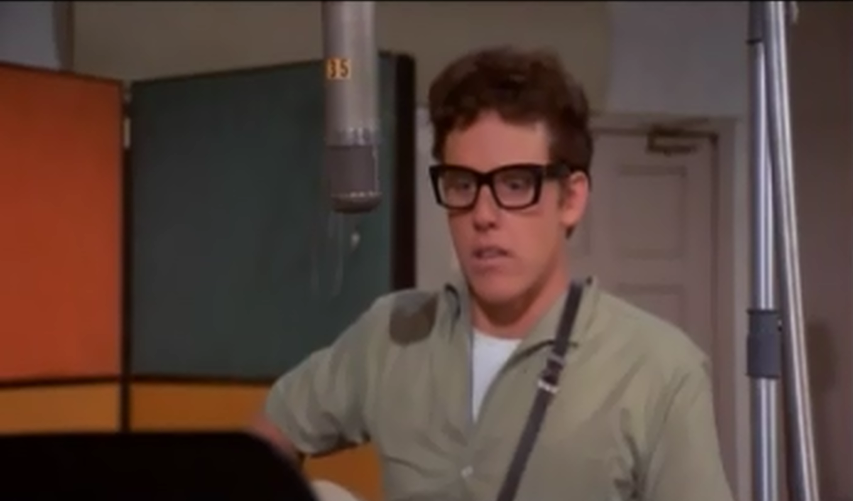
Rocktober: 'The Buddy Holly Story' (1978)
Buddy Holly had such a short life and even shorter career that there's not a whole lot of material to put in a movie about him, and director Steve Rash ends up altering much of it anyway for the entertaining but insubstantial The Buddy Holly Story. Unlike a lot of showbiz biopics, Story doesn't get to include a rise-and-fall story, since Holly was still going strong when he died in a plane crash in 1959 at age 22. So there's little tension to the story of Holly's success, which involves only mild hardship on the way to universal acclaim. Rash tries to make something of Holly's small-town roots, but the scenes of his parents and girlfriend trying to hold him back don't have much weight to them, and Holly achieves success so quickly that no one really has time to question his choices.
Likewise, the two band members of the Crickets (fictionalized versions of the three real people who played in Holly's band) are mostly relegated to background noise, and their brief conflicts with Holly (annoyed by his embrace of fame, critical of his Latina wife) don't amount to much. I kept waiting for Holly to develop substance-abuse problems, or end up in a toxic relationship, or get screwed over by an unscrupulous music-industry executive, but none of that stuff ever happened. In reality, there were a lot more twists and turns on Holly's road to success (he actually did get screwed over financially by his manager), but Rash chooses to focus on the positive, and it's surprisingly enjoyable much of the time.
Without a lot of drama to include, Rash focuses on the music, and that's where the movie really shines. While most musical biopics might just show enough of a performance to give the audience the sense of how the music came across, Rash shows Buddy and his band playing numerous songs in full, including an entire performance at the Apollo Theater in Harlem (where Holly and the Crickets won over an all-black audience) and nearly 10 minutes of Holly's final performance before his death. The actors played the music live, so there's an excitement to seeing what ends up looking like a concert movie, even if Gary Busey isn't anywhere near the performer and musician Holly was.
Contrary to his crazy-man persona later in life, Busey gives a solid, measured performance as Holly, and re-creates the songs well enough. He probably didn't deserve the Oscar nomination he got for the movie, but he's still enjoyable to watch, finding nuance in a portrayal of an essentially decent, upstanding guy. Rash makes the curious choice to end the movie without showing any of the drama leading up to Holly's death, but closing on the triumphant note of Holly onstage emphasizes one last time that this is a movie about music, not tragedy.
Saturday, October 27, 2012
Rocktober: 'The Song Remains the Same' (1976)
I'm a big Led Zeppelin fan, but even I got a little bored during some of the shapeless jamming in the band's concert film The Song Remains the Same. The footage of the band performing at Madison Square Garden in 1973 is often powerful, and certainly the band members are strong enough musicians to warrant extended solos, but when "Dazed and Confused" extends to nearly half an hour all on its own, it's hard not to get a little restless. So many of the songs ended up being long, drawn-out jams that by the final third of the movie I was really hoping the band would play something short and punchy. Even so, solos by guitarist Jimmy Page and drummer John Bonham are often fascinating to watch, and it's exciting to see the band at the height of its creativity.
There's more to The Song Remains the Same than just a straightforward concert documentary, though: The performance footage is broken up by silly fantasy sequences meant to represent the inner lives of the band members, and while it's smart for director Joe Massot not to call on the band members to speak any dialogue, the wordless music video-style interludes feel superfluous without an overall narrative tying them together. The Song Remains the Same isn't a rock opera, and so the fantasies don't have much meaning other than the band members goofing off. It is a little amusing to see how grandiose John Paul Jones, Robert Plant and Jimmy Page's segments are (Jones is a masked hero of some sort; Plant is a knight saving a damsel in distress; Page climbs a mountain and meets a mysterious hooded figure who turns out to be his older self) compared to Bonham's, which involves him working around the house, spending time with his family and racing cars.
I was more amused by the backstage footage (which, as a disclaimer notes at the end, was not shot at Madison Square Garden), including band manager Peter Grant berating a promoter for not cracking down hard enough on bootleg merchandise. It would have been nice to see more of that, maybe a more varied documentary on Zeppelin's tour, but the performance footage is still worthwhile for fans, even if the fantasy stuff doesn't really add anything to it.
Friday, October 26, 2012
Rocktober: 'Hedwig and the Angry Inch' (2001)
Like a lot of the movies I've written about for this project (The Wall, Tommy, The Great Rock 'n' Roll Swindle), John Cameron Mitchell's Hedwig and the Angry Inch is more impressionistic than it is a straightforward narrative, with musical numbers holding together a loose story about the tragic life of a transsexual rock singer (Mitchell). In the original stage version, Mitchell's Hedwig told the story of her life directly to the audience while backed by a live rock band, and while the movie opens up that format, it still feels at times like a one-man performance rather than a fully realized movie.
The story unfolds in fragments, often through the songs that Hedwig sings, as she tells of growing up as a boy in communist East Berlin, falling in love with an American soldier, getting the botched sex-change operation that left her with the titular "angry inch" and then moving to the U.S. The glammed-up flashbacks to war-torn Germany are definitely reminiscent of The Wall, and the occasional animated interludes also owe a bit to Pink Floyd.
Once in the U.S., Hedwig loses her husband and finds herself stranded in the Midwest, where she meets sheltered teen Tommy (Michael Pitt) and starts teaching him about rock n' roll and deviant sex. He becomes a rock star but disavows her, and so she's stuck playing low-rent seafood restaurants and telling her sad tale to the audience (hence the structure of the stage play). My favorite aspect of the movie was Hedwig's deadpan sense of humor; you'd expect such a larger-than-life character to be melodramatic and bombastic, which she is, but Mitchell does a great job of playing up the sarcastic jokes, and I could have used more of those.
Instead we get a muddled plot that's sometimes hard to follow, hammy musical numbers that are not particularly impressive, and some philosophical musings that fit awkwardly into the story. I really had trouble getting a handle on the relationship between Hedwig and Yitzhak, her husband/sidekick who doesn't really do anything in the band, and hangs out in the background looking vaguely put-upon. Yitzhak's journey figures prominently into the movie's climax, but I couldn't really figure out what it was supposed to mean. He's played by a woman (Miriam Shor) but as far as I can tell is meant to actually be a man who longs to be a woman (and not a woman in drag as a man). It's needlessly confusing and distracts from the central story about the relationship between Hedwig and Tommy.
Too much of the movie is like that -- needlessly confusing and distracting -- for it to hold together as a narrative, and even though I wasn't that taken with the songs, I can see how they might be enjoyable presented in the more straightforward format of the stage show. Hedwig makes for a pretty good rock star, but she's less successful as the main character of a movie.
Thursday, October 25, 2012
Rocktober: 'Purple Rain' (1984)
Prince is nobody's idea of a leading man. He may be a brilliant musician and a charismatic stage performer, but with his short stature, wispy mustache, soft voice and penchant for puffy shirts, he's not exactly movie-star material. Purple Rain ignores this and treats him like a dashing matinee idol, and it only makes his character more unsympathetic. Known only as "the Kid," he's a sullen local Minneapolis musician in competition with a flashy rival played by Morris Day. Virtually the entire cast is made up of Prince's musical associates playing versions of themselves (generally poorly), and somehow Prince comes off worst of all, with the Kid behaving like a petulant egomaniac, treating his band members and girlfriend terribly. The movie ends with his supposed redemption, but there's nothing to indicate that he's changed at all, nor any reason for any of the other characters to suddenly appreciate him.
Not that the plot is particularly coherent before that, either. The big conflict seems to hinge on whether Day will oust the Kid's band The Revolution (played by Prince's actual band The Revolution) from the nightclub where they both play by replacing them with a new girl group led by Apollonia (Apollonia Kotero). But the stakes never seem to be very high, and the Kid doesn't seem to care much about whether the band keeps its gig or not. Throughout the movie, he dismisses a new song written by band members Wendy & Lisa, only to finally embrace it at the end, when it turns out to be "Purple Rain." In real life, Prince, not Wendy & Lisa, wrote "Purple Rain," and Wendy & Lisa left The Revolution out of frustration that their contributions weren't being recognized. That's some heavy irony right there.
So the Kid treats his band members like trash, and when he hooks up with Apollonia, he treats her terribly, too, slapping her across the face when she says she's going to join Day's new girl group. It's implied that this behavior is a product of the Kid's origin in an abusive home (his father, played by Clarence Williams III in one of the movie's only performances by an actual actor, frequently beats his mother), but he never apologizes or appears to change his ways, and yet he gets the girl in the end anyway. When he's not slapping her, he belittles her and takes her for granted, and never seems to support her musical ambitions. Kotero, who recorded a Prince-produced album with girl group Apollonia 6, functions primarily as eye candy, and her love scenes with the Kid are hilariously cheesy.
I've never been a fan of Prince's music; I respect his talent, but his songs don't do anything for me (even when I've seen him perform live). But the live performances are easily the best part of Purple Rain, and given how half-assed the plot is, the movie probably would have been better off as a Prince performance film. That's essentially what it turns into in the last 15 minutes, when it gives up any semblance of story and just throws all the plot points out the window, declaring them resolved despite nothing having changed.
Subscribe to:
Posts (Atom)