On the 13th of each month, I write about a movie whose title contains the number 13.
Shot somewhere around 1999 but not released until 2005, Lucky 13 probably only found distribution after such a long time thanks to co-star Lauren Graham's Gilmore Girls fame. It certainly doesn't deserve attention for anything else -- not its lame, half-assed story, weak dialogue, annoying characters or unfunny jokes. And certainly not for charisma-free leading man Brad Hunt, whose performance is so smarmy that I initially assumed he must be the writer and director as well, putting together a vanity project about how attractive and charming he is.
But no, Hunt is just the crappy actor hired by actual director Chris Hall to play 20-something loser Zach, who's spent his entire life pining away for his neighbor Abbey (Graham). When Abbey announces she is moving to New York City to become an artist, Zach finally asks her out on a date, and he has just a few days to make himself the perfect boyfriend material for Abbey. Thus he decides to revisit all 12 of his past girlfriends to learn why he could never hold onto a relationship.
This is a pretty standard contrived rom-com setup, but Hall and his co-writers completely screw it up with terrible pacing, lame jokes and barely sketched characters, including all of Zach's exes, many of whom barely even get any lines. Only a couple of his exes actually serve their ostensible plot purpose and give him some advice; otherwise they just show up for bad jokes or as background filler. I'm not entirely sure there are even 12 of them.
In addition to Graham, Lucky 13 is full of soon-to-be-famous faces, including Kaley Cuoco, Jenna Fischer, Taryn Manning, Ever Carradine, Pamela Adlon and Sasha Alexander (also a producer on this mess). There's also Harland Williams in a surprisingly subdued performance as Zach's goofy best friend, plus X's John Doe and That '70s Show's Debra Jo Rupp as his parents. The movie isn't worthy of any of their talents.
Saturday, April 13, 2013
Friday, April 05, 2013
Bette Davis Month Bonus: 'The Golden Arrow' (1936)
Alfred E. Green directed Bette Davis in a number of her early films, including the 1932 hidden gem The Rich Are Always With Us. Green's The Golden Arrow isn't as entertaining as The Rich Are Always With Us, but it has a similar cheeky tone and playful attitude toward the quirks of the idle rich. Davis stars as what at first appears to be the heiress to a cosmetics fortune, a spoiled young woman who spends all her time lounging about on her yacht off the coast of Florida and entertaining various suitors. But Davis' Daisy is actually an actress hired to pretend to be a cosmetics heiress, in order to drum up publicity for the company.
This particular bit of information doesn't come to light until about halfway through the movie, after which Daisy has already proposed marriage to humble newspaper reporter Johnny Jones (perpetual Davis co-star George Brent), as a mutual business arrangement so he has leisure time to write his novel and she can fend off the advances of her persistent suitors. Except he still thinks she's a real heiress, and her bosses at the cosmetics company don't want her getting married at all. Got that? It's a convoluted setup that gets even more ridiculous as the movie goes on, but Green plays it all as light farce, and Davis has loads of fun as the street-smart dame who's infiltrated high society.
The ending involves a set piece built around some uncomfortable domestic violence humor, and the story kind of runs out of steam by that point anyway. But Davis and Brent have decent chemistry (although Brent is, as always, sort of bland by comparison), and the bits of sly commentary about the indulgences of the rich are entertaining and sharply delivered. It's rare to find a gem among these generic programmers that Davis made early in her career, so even though The Golden Arrow has its flaws, it still qualifies as a pleasant surprise.
This particular bit of information doesn't come to light until about halfway through the movie, after which Daisy has already proposed marriage to humble newspaper reporter Johnny Jones (perpetual Davis co-star George Brent), as a mutual business arrangement so he has leisure time to write his novel and she can fend off the advances of her persistent suitors. Except he still thinks she's a real heiress, and her bosses at the cosmetics company don't want her getting married at all. Got that? It's a convoluted setup that gets even more ridiculous as the movie goes on, but Green plays it all as light farce, and Davis has loads of fun as the street-smart dame who's infiltrated high society.
The ending involves a set piece built around some uncomfortable domestic violence humor, and the story kind of runs out of steam by that point anyway. But Davis and Brent have decent chemistry (although Brent is, as always, sort of bland by comparison), and the bits of sly commentary about the indulgences of the rich are entertaining and sharply delivered. It's rare to find a gem among these generic programmers that Davis made early in her career, so even though The Golden Arrow has its flaws, it still qualifies as a pleasant surprise.
Monday, April 01, 2013
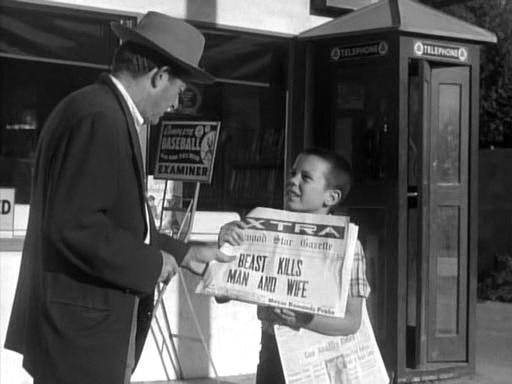
White Elephant Blogathon: 'The Beast of Yucca Flats' (1961)
Sadly, last year I missed out on the White Elephant Blogathon, in which bloggers submit movie suggestions to a pool and then write about a randomly chosen selection from another blogger, but I'm back on board this year. The first year I participated, I got something boring (Dr. Dolittle: Million Dollar Mutts), and the second year, I got something terrible (Scorpion Thunderbolt), and this year I got a movie that's both boring and terrible, Coleman Francis' The Beast of Yucca Flats.
Although Beast is probably best known for its appearance in an episode of Mystery Science Theater 3000, I did not cheat -- I watched the original film without any comedic commentary, although I did check out some MST3K clips online. And boy is this a movie that needs comedic commentary to liven things up. It's only 54 minutes long, but it feels like a lifetime, with maybe 10 minutes of plot crammed into endless scenes of cars driving and parking (seems Francis must have been a big influence on Birdemic's James Nguyen), all narrated semi-coherently by Francis himself, since there was no sound recorded during production.
That means that either Francis is narrating in his rambling, ponderous style (sometimes filling in plot and character details, sometimes waxing poetic about nuclear armageddon), or he's throwing in awkwardly dubbed dialogue that can only be delivered when characters are offscreen or have their faces obscured in some way (since none of the words match up to the movement of the actors' mouths). It's possible to achieve a sort of otherworldly effect this way, and the movie's opening scene (which seems to have no connection to the rest of the story), in which a nearly naked woman is strangled by an unseen brute as a clock ticks loudly, is actually pretty creepy.
But the rest of the movie is just moronic, with a Soviet scientist played by Ed Wood favorite Tor Johnson getting caught up in a nuclear blast and transformed into the beast of the title. Mostly that means he lumbers around the sparse landscape, occasionally listlessly choking some anonymous passerby. Francis fails at creating suspense or even shocks; Johnson looks less like a beast and more like a guy with a bad sunburn. He clumsily stalks incompetent cops and an annoying family on vacation, but none of the performances have enough energy to make the threat seem urgent or even particularly dangerous. When the beast is defeated, it's the final anticlimax in a movie that's just one long disappointment.
Kenji Fujishima wrote a fascinating post on my pick, Cannibal Women in the Avocado Jungle of Death, which I definitely need to revisit.
Although Beast is probably best known for its appearance in an episode of Mystery Science Theater 3000, I did not cheat -- I watched the original film without any comedic commentary, although I did check out some MST3K clips online. And boy is this a movie that needs comedic commentary to liven things up. It's only 54 minutes long, but it feels like a lifetime, with maybe 10 minutes of plot crammed into endless scenes of cars driving and parking (seems Francis must have been a big influence on Birdemic's James Nguyen), all narrated semi-coherently by Francis himself, since there was no sound recorded during production.
That means that either Francis is narrating in his rambling, ponderous style (sometimes filling in plot and character details, sometimes waxing poetic about nuclear armageddon), or he's throwing in awkwardly dubbed dialogue that can only be delivered when characters are offscreen or have their faces obscured in some way (since none of the words match up to the movement of the actors' mouths). It's possible to achieve a sort of otherworldly effect this way, and the movie's opening scene (which seems to have no connection to the rest of the story), in which a nearly naked woman is strangled by an unseen brute as a clock ticks loudly, is actually pretty creepy.
But the rest of the movie is just moronic, with a Soviet scientist played by Ed Wood favorite Tor Johnson getting caught up in a nuclear blast and transformed into the beast of the title. Mostly that means he lumbers around the sparse landscape, occasionally listlessly choking some anonymous passerby. Francis fails at creating suspense or even shocks; Johnson looks less like a beast and more like a guy with a bad sunburn. He clumsily stalks incompetent cops and an annoying family on vacation, but none of the performances have enough energy to make the threat seem urgent or even particularly dangerous. When the beast is defeated, it's the final anticlimax in a movie that's just one long disappointment.
Kenji Fujishima wrote a fascinating post on my pick, Cannibal Women in the Avocado Jungle of Death, which I definitely need to revisit.
Wednesday, March 13, 2013
Triskaidekaphilia: 'Last Stop on 13th Street' (1978)
On the 13th of each month, I write about a movie whose title contains the number 13.
Like 13teen, Last Stop on 13th Street is a cheapo B-movie slapped with a new title featuring the number 13 to make it sound more ominous. To be fair, it was originally released as Alien Zone, which is a far more nonsensical title, since there are no aliens anywhere in the movie (it's also known in some releases as The House of the Dead, which is by far the most accurate title), and there is at least a street (never indicated as 13th Street, though), at which one of the movie's main characters makes a last stop. But the title really has nothing to do with the plot, which features a philandering salesman making a wrong turn and ending up taken in by a charmingly sinister mortician (Ivor Francis, giving the movie's most effective performance).
The movie then turns into a sort of second-rate Twilight Zone or Tales From the Crypt, as the mortician takes the salesman through his parlor, opening a series of four coffins and telling stories about the inhabitants of each. The stories are pretty half-baked: A shrill teacher is murdered by some sort of child-monsters; a creepy guy films himself seducing/murdering women (featuring the least convincing onscreen strangulation I've ever seen), then gets caught; two master detectives entertain a deadly rivalry; and a callous businessman is tortured by unseen forces.
The detective story at least has a pair of fun performances and a satisfying (if painfully predictable) ending, and I could see it actually being a lesser episode of one of the shows the movie is copying. The rest of the stories are poorly paced and completely ineffective at creating suspense, and the framing sequence ends with the obvious twist that the adulterer is now the mortician's latest victim. The version of the movie I saw via Amazon Instant (obviously ripped from an old VHS tape, complete with tracking problems and murky, degraded image) is only 77 minutes long, and IMDb claims that there's a 100-minute cut out there somewhere, which might alleviate some of the choppiness, but is unlikely to improve the tedious plotting, lackluster acting and ugly visuals.
Like 13teen, Last Stop on 13th Street is a cheapo B-movie slapped with a new title featuring the number 13 to make it sound more ominous. To be fair, it was originally released as Alien Zone, which is a far more nonsensical title, since there are no aliens anywhere in the movie (it's also known in some releases as The House of the Dead, which is by far the most accurate title), and there is at least a street (never indicated as 13th Street, though), at which one of the movie's main characters makes a last stop. But the title really has nothing to do with the plot, which features a philandering salesman making a wrong turn and ending up taken in by a charmingly sinister mortician (Ivor Francis, giving the movie's most effective performance).
The movie then turns into a sort of second-rate Twilight Zone or Tales From the Crypt, as the mortician takes the salesman through his parlor, opening a series of four coffins and telling stories about the inhabitants of each. The stories are pretty half-baked: A shrill teacher is murdered by some sort of child-monsters; a creepy guy films himself seducing/murdering women (featuring the least convincing onscreen strangulation I've ever seen), then gets caught; two master detectives entertain a deadly rivalry; and a callous businessman is tortured by unseen forces.
The detective story at least has a pair of fun performances and a satisfying (if painfully predictable) ending, and I could see it actually being a lesser episode of one of the shows the movie is copying. The rest of the stories are poorly paced and completely ineffective at creating suspense, and the framing sequence ends with the obvious twist that the adulterer is now the mortician's latest victim. The version of the movie I saw via Amazon Instant (obviously ripped from an old VHS tape, complete with tracking problems and murky, degraded image) is only 77 minutes long, and IMDb claims that there's a 100-minute cut out there somewhere, which might alleviate some of the choppiness, but is unlikely to improve the tedious plotting, lackluster acting and ugly visuals.
Friday, February 22, 2013
'Out There'
Virtually no one watched last year's underrated (if uneven) FX animated series Unsupervised, so people probably won't notice how much it has in common with the new IFC animated series Out There. Although both shows have the familiar structure of dumb, vulgar animated comedies, both shows soon reveal themselves as something more thoughtful and true, more interested in the painful peculiarities of being a teen outcast than in crafting lame gross-out jokes.
Like Unsupervised, Out There focuses on a pair of teen misfits who team up against the world, two best friends who bond together almost out of desperation. Out There's Chad and Chris are more typical sullen teenage outcasts (as opposed to the relentlessly positive protagonists of Unsupervised), with crushes on girls and dreams of running away and frustrating parents who don't understand them. The actual plotting of the show isn't particularly groundbreaking, but creator Ryan Quincy has a distinctive personal perspective (much of the show is autobiographical) that shines through, especially in his narration and voicing of main character Chad.
Also like Unsupervised, Out There isn't actually all that funny, but while it does have jokes, it's also built around a sense of melancholy that pervades even the silliest moments. Quincy's narration has a literary quality that feels almost like a reading of a decent short story or personal essay, and there's a real sadness to the characters' efforts to look cool or escape their boring small town or impress a pretty girl. Visually, the characters look like sort of animal/human hybrids (Chad and his brother and father resemble relatives of Cousin Itt), but their behavior is completely grounded and realistic. Out There isn't brilliant -- it has plenty of clumsy moments and jokes that fall flat -- but it has a unique voice that deserves to find more of an audience than Unsupervised did.
Premieres tonight at 10:30 on IFC.
Like Unsupervised, Out There focuses on a pair of teen misfits who team up against the world, two best friends who bond together almost out of desperation. Out There's Chad and Chris are more typical sullen teenage outcasts (as opposed to the relentlessly positive protagonists of Unsupervised), with crushes on girls and dreams of running away and frustrating parents who don't understand them. The actual plotting of the show isn't particularly groundbreaking, but creator Ryan Quincy has a distinctive personal perspective (much of the show is autobiographical) that shines through, especially in his narration and voicing of main character Chad.
Also like Unsupervised, Out There isn't actually all that funny, but while it does have jokes, it's also built around a sense of melancholy that pervades even the silliest moments. Quincy's narration has a literary quality that feels almost like a reading of a decent short story or personal essay, and there's a real sadness to the characters' efforts to look cool or escape their boring small town or impress a pretty girl. Visually, the characters look like sort of animal/human hybrids (Chad and his brother and father resemble relatives of Cousin Itt), but their behavior is completely grounded and realistic. Out There isn't brilliant -- it has plenty of clumsy moments and jokes that fall flat -- but it has a unique voice that deserves to find more of an audience than Unsupervised did.
Premieres tonight at 10:30 on IFC.
Thursday, February 21, 2013
'Upload With Shaquille O'Neal'
I don't follow sports at all, but I find Shaquille O'Neal kind of fascinating because he's clearly so desperate to be an entertainer. While he was in the NBA, he took time out to star in terrible movies (Steel, Kazaam), record terrible albums (Shaq Diesel, Shaq Fu) and host terrible reality shows (Shaq's Big Challenge, Shaq Vs.). Now that he's retired from basketball, he's able to devote all of his time to pursuing his misguided goal of becoming America's most beloved seven-foot-tall TV personality.
The latest chapter in this ongoing effort is Upload With Shaquille O'Neal, a Tru TV show that's basically Shaq hosting America's Funniest Home Videos. Although the format is similar to Tosh.0 or MTV's Ridiculousness in that it features videos culled from the internet, the videos themselves are the exact same kind of thing you'd see on AFV, primarily focused on people falling down and/or hurting themselves comedically. It's no surprise, since AFV executive producer Vin di Bona is also behind Upload, and the format, with its family-friendly humor, "clip of the week" and slick announcer (I swear it's the same guy), is basically a copy of AFV.
As for Shaq himself, he's propped up by comedians Godfrey and Gary Owen as co-hosts, so he mostly sits there and laughs at the clips, and occasionally reads some corny jokes. He also stars in some lame sketches in between videos, which are about as clever as, well, Bob Saget's voiceovers on AFV. This is the kind of show you could watch with your entire family without worrying that anyone will be offended (or more than mildly entertained), and like AFV, it could run for years without anyone noticing. Wearing a sweater vest and delivering puns, Shaq has successfully transformed himself into Bob Saget circa 1992, and you get the impression he couldn't be happier about it.
Premieres tonight at 10:30 on Tru TV.
The latest chapter in this ongoing effort is Upload With Shaquille O'Neal, a Tru TV show that's basically Shaq hosting America's Funniest Home Videos. Although the format is similar to Tosh.0 or MTV's Ridiculousness in that it features videos culled from the internet, the videos themselves are the exact same kind of thing you'd see on AFV, primarily focused on people falling down and/or hurting themselves comedically. It's no surprise, since AFV executive producer Vin di Bona is also behind Upload, and the format, with its family-friendly humor, "clip of the week" and slick announcer (I swear it's the same guy), is basically a copy of AFV.
As for Shaq himself, he's propped up by comedians Godfrey and Gary Owen as co-hosts, so he mostly sits there and laughs at the clips, and occasionally reads some corny jokes. He also stars in some lame sketches in between videos, which are about as clever as, well, Bob Saget's voiceovers on AFV. This is the kind of show you could watch with your entire family without worrying that anyone will be offended (or more than mildly entertained), and like AFV, it could run for years without anyone noticing. Wearing a sweater vest and delivering puns, Shaq has successfully transformed himself into Bob Saget circa 1992, and you get the impression he couldn't be happier about it.
Premieres tonight at 10:30 on Tru TV.
Tuesday, February 19, 2013
'Cult'
In the last few weeks, we've had one terrible new network drama (The Following) about an insidious cult of serial killers, and another terrible new network drama (Zero Hour) about a convoluted, wide-ranging conspiracy. The CW's new drama Cult combines both of these misguided concepts into one series, and then adds in an evil television show for good measure. Creator Rockne S. O'Bannon (Farscape) has a decent reputation in genre TV, but the first episode of Cult is an incoherent mess, as laughably confused as Zero Hour and nearly as unpleasantly grim as The Following.
The idea is that a creepy TV show (which airs on The CW, of course) is somehow inspiring its most rabid fans to commit violent acts as directed by the main villain on the show. Or at least that's what seems to be happening, since the pilot is all about vague ominous hints and very few concrete details about what's going on. A disgraced reporter (Matthew Davis) whose brother has gone missing after investigating the show teams up with one of the show's researchers (Jessica Lucas) to dig into the mysterious activities of the fans, and they discover ... something sinister, although it's not exactly clear what that is.
Cult fails pretty miserably at creating a sense of danger and menace, exemplified by the "creepy" catch phrase that victims both on the show and in the real world utter just before dying ("Well hey, these things just snap right off"). All of the suspense is hilariously overwrought and completely unconvincing, and while there's a hint of campy satire in the portrayal of the network executive trying to give the show's reclusive-genius creator notes, Cult doesn't really have a coherent perspective on TV fandom or serialized genre entertainment. You'd think a genre TV show looking to engender a cult following would be good at representing a genre TV show with a cult following, but the show-within-the-show rings false. Thus we're left with the dour, incoherent mystery, which offers no enticement to tune in again. It's doubtful Cult will inspire its fans to do anything more drastic than change the channel.
Premieres tonight at 9 p.m. on The CW.
The idea is that a creepy TV show (which airs on The CW, of course) is somehow inspiring its most rabid fans to commit violent acts as directed by the main villain on the show. Or at least that's what seems to be happening, since the pilot is all about vague ominous hints and very few concrete details about what's going on. A disgraced reporter (Matthew Davis) whose brother has gone missing after investigating the show teams up with one of the show's researchers (Jessica Lucas) to dig into the mysterious activities of the fans, and they discover ... something sinister, although it's not exactly clear what that is.
Cult fails pretty miserably at creating a sense of danger and menace, exemplified by the "creepy" catch phrase that victims both on the show and in the real world utter just before dying ("Well hey, these things just snap right off"). All of the suspense is hilariously overwrought and completely unconvincing, and while there's a hint of campy satire in the portrayal of the network executive trying to give the show's reclusive-genius creator notes, Cult doesn't really have a coherent perspective on TV fandom or serialized genre entertainment. You'd think a genre TV show looking to engender a cult following would be good at representing a genre TV show with a cult following, but the show-within-the-show rings false. Thus we're left with the dour, incoherent mystery, which offers no enticement to tune in again. It's doubtful Cult will inspire its fans to do anything more drastic than change the channel.
Premieres tonight at 9 p.m. on The CW.
Wednesday, February 13, 2013
Triskaidekaphilia: '1313: Actor Slash Model' (2011)
On the 13th of each month, I write about a movie whose title contains the number 13.
According to Wikipedia, Z-grade filmmaker David DeCoteau has made more than 90 feature films in the past 25 years, and his latest assembly-line brand is the 1313 series, quickie straight-to-video "thrillers" marketed to a gay male audience despite containing no actual gay content whatsoever. Instead, these movies, all of which run less than 80 minutes and many of which were apparently shot in the same prefab mansion, feature shirtless young hunks wandering around aimlessly, working out, swimming and occasionally stumbling across something resembling a plot. There's no sex or even kissing, and no nudity beyond the kind of shirtlessness you could find in an Abercrombie & Fitch catalog.
Despite my dedication to this ongoing project, I have no intention of watching more than one of these 1313 movies, which by all accounts are interchangeable. So I picked what may be the first one (it's hard to tell, since DeCoteau churns them out so quickly), Actor Slash Model, which is at least a somewhat clever title for the story of a disgruntled actor murdering the pretty-boy models who keep getting the parts he wants. But as indicated above, the movie spends maybe 10-15 minutes on the actual plot, which boils down to the killer wandering around the empty mansion and killing vapid hunks one by one. DeCoteau is so focused on beefcake that he doesn't even bother delivering any thrills; the killer carries around what looks like a small kitchen knife, and each murder scene cuts away before we can see the actual stabbing. The knife is always clean afterward; it's as if the production didn't even have the budget for some fake blood and a prop knife.
DeCoteau's idea of suspense is to blare loud, "ominous" music over endless scenes of actors slowly walking through the empty house, calling out "Hello?" over and over again (these scenes go on for literally three or four minutes at a time). The actors are good-looking in a generic way, but, perhaps in an inadvertent nod to the plot, give terrible performances, and some can't even keep the other character names straight between scenes (DeCoteau's other "suspense" technique of replaying previous dialogue over the lengthy walking scenes ends up repeating one particularly egregious name mix-up over and over again).
I guess these movies must be some sort of success with gay viewers, because DeCoteau has made at least 14 of them (again, according to Wikipedia), but to me they seem insulting and condescending. DeCoteau panders to his audience by showcasing shirtless hunks, but then backs off from any themes or dialogue or plot points that might be relevant to the people he's supposedly trying to reach. I'm sure he'd defend his work as harmless fluff, but it's really just tedious nonsense, and anyone looking to ogle shirtless dudes can find numerous better ways to do so.
According to Wikipedia, Z-grade filmmaker David DeCoteau has made more than 90 feature films in the past 25 years, and his latest assembly-line brand is the 1313 series, quickie straight-to-video "thrillers" marketed to a gay male audience despite containing no actual gay content whatsoever. Instead, these movies, all of which run less than 80 minutes and many of which were apparently shot in the same prefab mansion, feature shirtless young hunks wandering around aimlessly, working out, swimming and occasionally stumbling across something resembling a plot. There's no sex or even kissing, and no nudity beyond the kind of shirtlessness you could find in an Abercrombie & Fitch catalog.
Despite my dedication to this ongoing project, I have no intention of watching more than one of these 1313 movies, which by all accounts are interchangeable. So I picked what may be the first one (it's hard to tell, since DeCoteau churns them out so quickly), Actor Slash Model, which is at least a somewhat clever title for the story of a disgruntled actor murdering the pretty-boy models who keep getting the parts he wants. But as indicated above, the movie spends maybe 10-15 minutes on the actual plot, which boils down to the killer wandering around the empty mansion and killing vapid hunks one by one. DeCoteau is so focused on beefcake that he doesn't even bother delivering any thrills; the killer carries around what looks like a small kitchen knife, and each murder scene cuts away before we can see the actual stabbing. The knife is always clean afterward; it's as if the production didn't even have the budget for some fake blood and a prop knife.
DeCoteau's idea of suspense is to blare loud, "ominous" music over endless scenes of actors slowly walking through the empty house, calling out "Hello?" over and over again (these scenes go on for literally three or four minutes at a time). The actors are good-looking in a generic way, but, perhaps in an inadvertent nod to the plot, give terrible performances, and some can't even keep the other character names straight between scenes (DeCoteau's other "suspense" technique of replaying previous dialogue over the lengthy walking scenes ends up repeating one particularly egregious name mix-up over and over again).
I guess these movies must be some sort of success with gay viewers, because DeCoteau has made at least 14 of them (again, according to Wikipedia), but to me they seem insulting and condescending. DeCoteau panders to his audience by showcasing shirtless hunks, but then backs off from any themes or dialogue or plot points that might be relevant to the people he's supposedly trying to reach. I'm sure he'd defend his work as harmless fluff, but it's really just tedious nonsense, and anyone looking to ogle shirtless dudes can find numerous better ways to do so.
Monday, February 04, 2013
'Monday Mornings'
I don't trust David E. Kelley. It seems that no matter how his shows start out, they eventually devolve into the same Kelley formula of absurd twists, overly quirky characters and heavy-handed speechifying. His new medical drama Monday Mornings seems pretty subdued in its first three episodes, at least compared to the later years of shows like Ally McBeal and Boston Legal (the two Kelley shows I followed most closely), but it definitely has some of the Kelley warning signs. There are little character quirks that start to become more prominent (one doctor has a habit of swaying back and forth on his squeaky sneakers when nervous, a tic that director Bill D'Elia, a longtime Kelley collaborator, always shoots in close-up), and there is plenty of melodramatic grandstanding, which is pretty much built into the show's concept.
The title refers to meetings/inquisitions held by the chief of staff at the show's fictional Chelsea General Hospital in Portland, Oregon, at which he dresses down doctors for their various failings during the previous week. This gives Alfred Molina, as the chief of staff, the chance to deliver at least one self-righteous monologue per episode, and the actors playing the other doctors rotate their own impassioned speeches depending on the storyline. There's a lot of overwrought emoting from patients and doctors, which D'Elia highlights with showy camerawork, and the interpersonal drama is pretty underdeveloped.
When the show isn't displaying Kelley's worst tendencies, it's a generic medical drama, with life-or-death cases, heartbreaking surgical complications and miracle diagnoses. I have a pretty low tolerance for that sort of thing, but fans of medical dramas may find something appealing in Mornings' various cases-of-the-week. Kelley has also assembled an impressive cast, including Molina, Ving Rhames, Jennifer Finnigan and Jamie Bamber, and there's an admirable diversity in the casting. But that can't make up for the problems with the writing and directing, and Kelley is probably just going to squander the show's strengths by the end of the season anyway.
Premieres tonight at 10 p.m. on TNT.
The title refers to meetings/inquisitions held by the chief of staff at the show's fictional Chelsea General Hospital in Portland, Oregon, at which he dresses down doctors for their various failings during the previous week. This gives Alfred Molina, as the chief of staff, the chance to deliver at least one self-righteous monologue per episode, and the actors playing the other doctors rotate their own impassioned speeches depending on the storyline. There's a lot of overwrought emoting from patients and doctors, which D'Elia highlights with showy camerawork, and the interpersonal drama is pretty underdeveloped.
When the show isn't displaying Kelley's worst tendencies, it's a generic medical drama, with life-or-death cases, heartbreaking surgical complications and miracle diagnoses. I have a pretty low tolerance for that sort of thing, but fans of medical dramas may find something appealing in Mornings' various cases-of-the-week. Kelley has also assembled an impressive cast, including Molina, Ving Rhames, Jennifer Finnigan and Jamie Bamber, and there's an admirable diversity in the casting. But that can't make up for the problems with the writing and directing, and Kelley is probably just going to squander the show's strengths by the end of the season anyway.
Premieres tonight at 10 p.m. on TNT.
Sunday, January 13, 2013
Triskaidekaphilia: 'The Professional: Golgo 13' (1983)
On the 13th of each month, I write about a movie whose title contains the number 13.
Japanese animation is one of my serious movie blind spots; I've seen only a handful of movies (three, I think, counting this one), and I find much of the style off-putting, although I realize it's unfair to generalize an entire varied genre that way. The point being, I may not really know what I'm talking about here, and seasoned anime fans could probably offer up better context for The Professional: Golgo 13, the first animated feature based on popular, long-running Japanese comics character Golgo 13 (aka Duke Togo).
Golgo 13 comics have been published continuously since 1969, and the character was adapted into two live-action movies (in 1973 and 1977) before this, as well as a later direct-to-video animated special and an animated series in 2008. I remember first hearing about the character thanks to the 1988 Golgo 13 video game for the original NES, but I don't think I knew much about him. Not that there's really that much to know: Golgo 13 is a mysterious assassin-for-hire whose nationality, age and real name are unknown. At least in this movie, he's essentially invincible and infallible, never missing his targets and never getting killed or more than lightly injured, despite being shot at by dozens of trained killers, caught in explosions and thrown from moving vehicles.
He also rarely speaks and never changes his grim facial expression, even while being surrounded by attackers or having sex with beautiful women (possibly the funniest moment in the movie occurs when some random hottie is writhing in ecstasy on top of Duke, and he just lies there, completely stoic). It all makes him into a completely uninteresting character, so the movie has to rely on the various villains, sex partners and hangers-on for its meager character development. The story is episodic in the movie's first half, but eventually ties together when Duke finds himself on the run from a cabal of CIA, FBI and military forces hired by an ultra-wealthy industrialist to take him out. Since he might as well be a superhero, things don't really go as planned for the bad guys.
Golgo 13 is full of anime's visual trademarks, including speed lines, abstract action sequences, split screens and static backgrounds. It also has one of the earliest uses of computer-generated animation, which as expected looks awkward and stiff. To me, the movie is hokey and laughable (the horrendous smooth-jazz score is particularly egregious), but some fans at least seem to regard it as an anime classic. With its insanely over-the-top violence and sex, overwrought dialogue and hammy acting (from the drawings as well as the voices), it's really just another artifact of '80s movie excess.
Japanese animation is one of my serious movie blind spots; I've seen only a handful of movies (three, I think, counting this one), and I find much of the style off-putting, although I realize it's unfair to generalize an entire varied genre that way. The point being, I may not really know what I'm talking about here, and seasoned anime fans could probably offer up better context for The Professional: Golgo 13, the first animated feature based on popular, long-running Japanese comics character Golgo 13 (aka Duke Togo).
Golgo 13 comics have been published continuously since 1969, and the character was adapted into two live-action movies (in 1973 and 1977) before this, as well as a later direct-to-video animated special and an animated series in 2008. I remember first hearing about the character thanks to the 1988 Golgo 13 video game for the original NES, but I don't think I knew much about him. Not that there's really that much to know: Golgo 13 is a mysterious assassin-for-hire whose nationality, age and real name are unknown. At least in this movie, he's essentially invincible and infallible, never missing his targets and never getting killed or more than lightly injured, despite being shot at by dozens of trained killers, caught in explosions and thrown from moving vehicles.
He also rarely speaks and never changes his grim facial expression, even while being surrounded by attackers or having sex with beautiful women (possibly the funniest moment in the movie occurs when some random hottie is writhing in ecstasy on top of Duke, and he just lies there, completely stoic). It all makes him into a completely uninteresting character, so the movie has to rely on the various villains, sex partners and hangers-on for its meager character development. The story is episodic in the movie's first half, but eventually ties together when Duke finds himself on the run from a cabal of CIA, FBI and military forces hired by an ultra-wealthy industrialist to take him out. Since he might as well be a superhero, things don't really go as planned for the bad guys.
Golgo 13 is full of anime's visual trademarks, including speed lines, abstract action sequences, split screens and static backgrounds. It also has one of the earliest uses of computer-generated animation, which as expected looks awkward and stiff. To me, the movie is hokey and laughable (the horrendous smooth-jazz score is particularly egregious), but some fans at least seem to regard it as an anime classic. With its insanely over-the-top violence and sex, overwrought dialogue and hammy acting (from the drawings as well as the voices), it's really just another artifact of '80s movie excess.
Monday, January 07, 2013
'Deception'
The obvious point of comparison for NBC's new drama Deception is ABC's Revenge: Both involve attractive young women with hidden agendas infiltrating wealthy, corrupt families in the Hamptons. But while Revenge is an unabashed soap opera, Deception seems, at least from the first episode, to be going for more of a serious crime-drama feel. With its hints of a grand conspiracy, it's really no less ludicrous than Revenge, but the creators are playing things straight for now.
Straight also means mostly dull in the first episode, which introduces police detective Joanna Locasto (Meagan Good), the daughter of the former housekeeper for the ultra-rich Bowers family. When daughter Vivian Bowers, Joanna's childhood best friend, is found dead of what appears to be a drug overdose (but is suspected of being murder), Joanna gets sent undercover as herself, to infiltrate the Bowers family and discover the truth about Vivian.
There are plenty of juicy plot elements just in the first episode (the Bowers family pharmaceutical company may be releasing a deadly drug! Joanna used to hook up with Vivian's brother when they were teens! Vivian's older brother was once accused of rape and murder!), including a big plot twist at the end, but it's all played so grim and somber that it doesn't really get a chance to be much fun. The hints of a conspiracy around the family pharmaceutical company seem to indicate a rather uninteresting storyline, and the relationship drama (including Joanna's on-again, off-again romance with her FBI handler) is similarly lifeless.
Good is an appealing lead, and Victor Garber does typically solid work as the Bowers family patriarch. Tate Donovan's performance as Vivian's maybe-rapist brother connects Deception to Damages, another soapy crime drama that took its outlandish twists way too seriously. Despite the fairly novel (for TV) set-up of an African-American lead in a show with a white supporting cast, the first episode doesn't have a single thing to say about race (or class, for that matter). The pilot makes Deception seem like it's going to end up being the world's longest Law & Order episode, and that's not something I'm particularly interested in sticking around for.
Premieres tonight at 10 p.m. on NBC.
Straight also means mostly dull in the first episode, which introduces police detective Joanna Locasto (Meagan Good), the daughter of the former housekeeper for the ultra-rich Bowers family. When daughter Vivian Bowers, Joanna's childhood best friend, is found dead of what appears to be a drug overdose (but is suspected of being murder), Joanna gets sent undercover as herself, to infiltrate the Bowers family and discover the truth about Vivian.
There are plenty of juicy plot elements just in the first episode (the Bowers family pharmaceutical company may be releasing a deadly drug! Joanna used to hook up with Vivian's brother when they were teens! Vivian's older brother was once accused of rape and murder!), including a big plot twist at the end, but it's all played so grim and somber that it doesn't really get a chance to be much fun. The hints of a conspiracy around the family pharmaceutical company seem to indicate a rather uninteresting storyline, and the relationship drama (including Joanna's on-again, off-again romance with her FBI handler) is similarly lifeless.
Good is an appealing lead, and Victor Garber does typically solid work as the Bowers family patriarch. Tate Donovan's performance as Vivian's maybe-rapist brother connects Deception to Damages, another soapy crime drama that took its outlandish twists way too seriously. Despite the fairly novel (for TV) set-up of an African-American lead in a show with a white supporting cast, the first episode doesn't have a single thing to say about race (or class, for that matter). The pilot makes Deception seem like it's going to end up being the world's longest Law & Order episode, and that's not something I'm particularly interested in sticking around for.
Premieres tonight at 10 p.m. on NBC.
Wednesday, January 02, 2013
My top non-2012 movies of 2012
At the end of each of the last few years, I've posted a list of my favorite movies from other years that I saw for the first time during that year (here are my lists from 2011, 2010, 2009 and 2008), but for various reasons (mostly an increase in non-movie-related writing assignments), I didn't see as many older movies this year as I have in recent years. So rather than fill out a list with movies I wasn't that enthused about, here instead is a shortened list of my top six non-2012 movies that I saw for the first time in 2012.
1. Bonjour Tristesse (Otto Preminger, 1958) Thank goodness for the TCM Classic Film Festival, at which I saw three of the movies on this list, including this wonderful unheralded masterpiece from Preminger, a filmmaker with a long, eclectic career spanning thrillers (Laura, Anatomy of a Murder), musicals (Carmen Jones, Porgy and Bess), romances (Forever Amber, Daisy Kenyon) and social-issue dramas (The Man With the Golden Arm, Advise & Consent). Bonjour Tristesse is none of those, although it is at times thrilling, romantic and socially relevant, all while maintaining a completely unique and surprising tone. Jean Seberg is delightful as a flighty young woman who both wants to rebel against her playboy father (David Niven) and keep him all to herself. Preminger mixes a breezy, adventurous sensibility with a core of real heartbreak and loss.
2. Cry Danger (Robert Parrish, 1951) Another discovery from TCM Fest, this clever, well-written noir both embraces and subverts familiar genre elements, including the femme fatale and the convoluted double-crossing. A passion project for star Dick Powell, it showcases him at his best playing a sardonic criminal looking to recover some money owed to him, a seemingly simple task which naturally spirals out of control. Rhonda Fleming is also very entertaining as the love interest/obstacle, and the movie skillfully integrates dry wit with genuine menace. Read more in my review.
3. Girl Shy (Fred C. Newmeyer and Sam Taylor, 1924) One more selection from TCM Fest, this one a silent comedy starring Harold Lloyd, who often ends up being an afterthought compared to Charlie Chaplin and Buster Keaton. But to be honest I enjoyed this more than any Keaton or Chaplin movie I've seen (which is admittedly not that many), finding it creative and heartfelt and genuinely funny in a way that those other movies just haven't been for me. Lloyd stages some amazing set pieces (including a mind-boggling car chase), but he also does a great job of developing a believable tragic character within the context of the over-the-top comedy.
4. Rampart (Oren Moverman, 2011) Every year I end up spending a bunch of time in January and February catching up on some notable end-of-year releases from the previous year, and this is one acclaimed 2011 movie that I didn't end up seeing until it opened in Vegas in March. The film itself can be a little unfocused, but Woody Harrelson's performance as a conflicted corrupt cop is excellent, and I like how Moverman is more concerned with character study than with procedural details, despite the story's basis in a real-life scandal. Read more in my review.
5. Ben-Hur (William Wyler, 1959) I appreciate when theater chains and companies like Fathom Events hold special screenings of older films on big screens, and I always mean to attend more of them (they often fall on evenings when I have to attend press screenings). This is one of the few I managed to make it to this year, and seeing this movie in a theater (actually on the oversized XD screen at the Cinemark South Point here in Vegas) was a really impressive experience. This is pretty much the definition of epic filmmaking, and Wyler conveys the scope and grandeur of the story in a way that I'm not sure anyone can anymore. Even with all the advances in modern special effects, the chariot-race sequence in this film is still one of the most astonishing things I've ever seen onscreen. The sheer scale of the movie can get exhausting, and I found the insistent, overt preaching at the end a little frustrating, but overall this is a pretty amazing cinematic achievement.
6. The Lady Eve (Preston Sturges, 1941) This is the third time I've had a Sturges movie on this list (I listed The Palm Beach Story in 2010 and Sullivan's Travels in 2008), and I'm repeatedly amazed at his cleverness and creativity, especially within the confines of Hollywood studio movies in the 1940s. The plot twists in the movie, featuring Barbara Stanwyck as a con artist with whom Henry Fonda falls repeatedly in love, are completely outlandish, but Sturges commits to them in such a wholehearted way that they feel almost natural. That's his consistent skill: Telling stories that are completely unpredictable and surprising, yet hold together remarkably from moment to moment. The Lady Eve is easily up there with his best work.
Honorable mention to two movies that I saw this year for the second time but enjoyed much more than I had initially: Josie and the Pussycats (Harry Elfont and Deborah Kaplan, 2001), which is even more incisive and amusing in its music-biz satire now than it was a decade ago; and The Exorcist (William Friedkin, 1973), which probably suffered from heightened expectations the first time I saw it, but which really impressed me years later (on the big screen, like Ben-Hur), with the intensity of its emotional drama and the seriousness of its religious inquiry (plus Linda Blair's amazing performance).
1. Bonjour Tristesse (Otto Preminger, 1958) Thank goodness for the TCM Classic Film Festival, at which I saw three of the movies on this list, including this wonderful unheralded masterpiece from Preminger, a filmmaker with a long, eclectic career spanning thrillers (Laura, Anatomy of a Murder), musicals (Carmen Jones, Porgy and Bess), romances (Forever Amber, Daisy Kenyon) and social-issue dramas (The Man With the Golden Arm, Advise & Consent). Bonjour Tristesse is none of those, although it is at times thrilling, romantic and socially relevant, all while maintaining a completely unique and surprising tone. Jean Seberg is delightful as a flighty young woman who both wants to rebel against her playboy father (David Niven) and keep him all to herself. Preminger mixes a breezy, adventurous sensibility with a core of real heartbreak and loss.
2. Cry Danger (Robert Parrish, 1951) Another discovery from TCM Fest, this clever, well-written noir both embraces and subverts familiar genre elements, including the femme fatale and the convoluted double-crossing. A passion project for star Dick Powell, it showcases him at his best playing a sardonic criminal looking to recover some money owed to him, a seemingly simple task which naturally spirals out of control. Rhonda Fleming is also very entertaining as the love interest/obstacle, and the movie skillfully integrates dry wit with genuine menace. Read more in my review.
3. Girl Shy (Fred C. Newmeyer and Sam Taylor, 1924) One more selection from TCM Fest, this one a silent comedy starring Harold Lloyd, who often ends up being an afterthought compared to Charlie Chaplin and Buster Keaton. But to be honest I enjoyed this more than any Keaton or Chaplin movie I've seen (which is admittedly not that many), finding it creative and heartfelt and genuinely funny in a way that those other movies just haven't been for me. Lloyd stages some amazing set pieces (including a mind-boggling car chase), but he also does a great job of developing a believable tragic character within the context of the over-the-top comedy.
4. Rampart (Oren Moverman, 2011) Every year I end up spending a bunch of time in January and February catching up on some notable end-of-year releases from the previous year, and this is one acclaimed 2011 movie that I didn't end up seeing until it opened in Vegas in March. The film itself can be a little unfocused, but Woody Harrelson's performance as a conflicted corrupt cop is excellent, and I like how Moverman is more concerned with character study than with procedural details, despite the story's basis in a real-life scandal. Read more in my review.
5. Ben-Hur (William Wyler, 1959) I appreciate when theater chains and companies like Fathom Events hold special screenings of older films on big screens, and I always mean to attend more of them (they often fall on evenings when I have to attend press screenings). This is one of the few I managed to make it to this year, and seeing this movie in a theater (actually on the oversized XD screen at the Cinemark South Point here in Vegas) was a really impressive experience. This is pretty much the definition of epic filmmaking, and Wyler conveys the scope and grandeur of the story in a way that I'm not sure anyone can anymore. Even with all the advances in modern special effects, the chariot-race sequence in this film is still one of the most astonishing things I've ever seen onscreen. The sheer scale of the movie can get exhausting, and I found the insistent, overt preaching at the end a little frustrating, but overall this is a pretty amazing cinematic achievement.
6. The Lady Eve (Preston Sturges, 1941) This is the third time I've had a Sturges movie on this list (I listed The Palm Beach Story in 2010 and Sullivan's Travels in 2008), and I'm repeatedly amazed at his cleverness and creativity, especially within the confines of Hollywood studio movies in the 1940s. The plot twists in the movie, featuring Barbara Stanwyck as a con artist with whom Henry Fonda falls repeatedly in love, are completely outlandish, but Sturges commits to them in such a wholehearted way that they feel almost natural. That's his consistent skill: Telling stories that are completely unpredictable and surprising, yet hold together remarkably from moment to moment. The Lady Eve is easily up there with his best work.
Honorable mention to two movies that I saw this year for the second time but enjoyed much more than I had initially: Josie and the Pussycats (Harry Elfont and Deborah Kaplan, 2001), which is even more incisive and amusing in its music-biz satire now than it was a decade ago; and The Exorcist (William Friedkin, 1973), which probably suffered from heightened expectations the first time I saw it, but which really impressed me years later (on the big screen, like Ben-Hur), with the intensity of its emotional drama and the seriousness of its religious inquiry (plus Linda Blair's amazing performance).
Monday, December 31, 2012
My top 10 comic books of 2012
I haven't written much about comics here lately, mainly because I tend to be behind on my reading and anything I have to say would end up not being very timely. But I'm still an avid comics reader, and this year I've also been an occasional contributor to Comic Book Resources, including writing a few items for their list of the top 100 comics of 2012. Since my pieces are scattered throughout the list, and some weren't used, I thought I'd reprint them all here, in order. So here are my top 10 comic book series of 2012.
1. The Unwritten (Mike Carey/Peter Gross; DC/Vertigo) Even after nearly 50 issues, Carey and Gross can still find new avenues to explore in their examination of the way storytelling influences every aspect of society, and they're constantly pushing their own storytelling abilities along the way. As emotionally affecting as it is intellectually challenging.
2. Saga (Brian K. Vaughan/Fiona Staples; Image) Totally upending preconceptions about epic sci-fi,Vaughan and Staples bring snappy, postmodern dialogue and self-aware characters into a worlds-spanning space opera, creating something that feels wonderfully new yet honors all of its various influences.
3. Fatale (Ed Brubaker/Sean Phillips; Image) Pretty much everything Brubaker and Phillips do well (noir-style visuals, hard-boiled dialogue, ingenious plot twists, seductive women, compromised men, mixing the supernatural with the mundane) all combined into one fascinating series.
4. Prophet (Brandon Graham/Simon Roy, Giannis Milonogiannis & Farel Dalrymple; Image) I have to admit that I only understand about a third of what goes on in this bizarre, endlessly creative series, but I love every bit of it. Graham has taken Rob Liefeld's muscled-up creation and made him into a melancholy avatar of sci-fi craziness.
5. Irredeemable/Incorruptible (Mark Waid/Peter Krause, Diego Barreto & Damian Couceiro; Boom!) Waid wrapped up his linked series about a superhero gone bad and a supervillian gone good with impeccable skill, bringing in serious themes about the nature of responsibility and the power of childhood influences while also telling a fun, action-packed superhero story.
6. Alabaster: Wolves (Caitlin R. Kiernan/Steve Lieber; Dark Horse) Kiernan's supernatural Southern gothic is a showcase for her twisted take on religion, with demon-hunter Dancy Flammarion representing the more unforgiving side of God's plan.
7. Chew (John Layman/Rob Guillory; Image) Consistently weird, inventive, hilarious, unpredictable and surprisingly deep for a comic about a guy who can see an object's past by chowing down on it.
8. The New Deadwardians (Dan Abnett/I.N.J. Culbard; DC/Vertigo) Did I know I wanted to read a series that crossed The Walking Dead with Downton Abbey? No, but apparently it was exactly the right combination.
9. Revival (Tim Seeley/Mike Norton; Image) Seeley and Norton manage to come up with an intriguing twist on the tired zombie formula, mixing horrific acts with solid family drama.
10. Animal Man (Jeff Lemire/Travel Foreman & Steve Pugh, DC) In the midst of the New 52, Lemire has created a haunting horror series about the lengths one man will go to protect his family.
1. The Unwritten (Mike Carey/Peter Gross; DC/Vertigo) Even after nearly 50 issues, Carey and Gross can still find new avenues to explore in their examination of the way storytelling influences every aspect of society, and they're constantly pushing their own storytelling abilities along the way. As emotionally affecting as it is intellectually challenging.
2. Saga (Brian K. Vaughan/Fiona Staples; Image) Totally upending preconceptions about epic sci-fi,Vaughan and Staples bring snappy, postmodern dialogue and self-aware characters into a worlds-spanning space opera, creating something that feels wonderfully new yet honors all of its various influences.
3. Fatale (Ed Brubaker/Sean Phillips; Image) Pretty much everything Brubaker and Phillips do well (noir-style visuals, hard-boiled dialogue, ingenious plot twists, seductive women, compromised men, mixing the supernatural with the mundane) all combined into one fascinating series.
4. Prophet (Brandon Graham/Simon Roy, Giannis Milonogiannis & Farel Dalrymple; Image) I have to admit that I only understand about a third of what goes on in this bizarre, endlessly creative series, but I love every bit of it. Graham has taken Rob Liefeld's muscled-up creation and made him into a melancholy avatar of sci-fi craziness.
5. Irredeemable/Incorruptible (Mark Waid/Peter Krause, Diego Barreto & Damian Couceiro; Boom!) Waid wrapped up his linked series about a superhero gone bad and a supervillian gone good with impeccable skill, bringing in serious themes about the nature of responsibility and the power of childhood influences while also telling a fun, action-packed superhero story.
6. Alabaster: Wolves (Caitlin R. Kiernan/Steve Lieber; Dark Horse) Kiernan's supernatural Southern gothic is a showcase for her twisted take on religion, with demon-hunter Dancy Flammarion representing the more unforgiving side of God's plan.
7. Chew (John Layman/Rob Guillory; Image) Consistently weird, inventive, hilarious, unpredictable and surprisingly deep for a comic about a guy who can see an object's past by chowing down on it.
8. The New Deadwardians (Dan Abnett/I.N.J. Culbard; DC/Vertigo) Did I know I wanted to read a series that crossed The Walking Dead with Downton Abbey? No, but apparently it was exactly the right combination.
9. Revival (Tim Seeley/Mike Norton; Image) Seeley and Norton manage to come up with an intriguing twist on the tired zombie formula, mixing horrific acts with solid family drama.
10. Animal Man (Jeff Lemire/Travel Foreman & Steve Pugh, DC) In the midst of the New 52, Lemire has created a haunting horror series about the lengths one man will go to protect his family.
Thursday, December 13, 2012
Triskaidekaphilia: 'Assault on Precinct 13' (2005)
On the 13th of each month, I write about a movie whose title contains the number 13.
A year ago, I wrote about John Carpenter's lean 1976 thriller Assault on Precinct 13, which I found even more impressive on second viewing. The 2005 remake, directed by French filmmaker Jean-Francois Richet, is not nearly as good, losing most of what made Carpenter's film successful and turning the story into a mundane crime thriller that makes little sense. A big part of the appeal of Carpenter's film is its simplicity, and Richet and screenwriter James DeMonaco lose that right away, spending the first several minutes of the movie establishing a tragic back story for main character Sgt. Jake Roenick (Ethan Hawke). Even worse, the faceless, almost zombie-like gang members who besieged the nearly abandoned police precinct in the original film have turned into talkative villains with convoluted motivations, which become less and less believable the more we learn about them.
In an interview earlier this year, Hawke said that he "just looked depressed" throughout this movie, and indeed the entire cast seems pretty dispirited, although Laurence Fishburne is good at delivering silky menace as crime boss Marion Bishop, whose presence in a holding cell in the broken-down old police station is the catalyst behind the siege. As Roenick, Hawke does project an air of world-weariness, but the character's angst doesn't really amount to much. The cast also includes Maria Bello, Brian Dennehy, Gabriel Byrne and John Leguizamo, but they're all playing stock types, from the mustache-twirling corrupt cop to the aging officer just on the verge of retirement.
Richet creates some moderately suspenseful moments, but the story drags on for way too long, especially when the entire climax takes place outside the precinct and involves a lame and obvious plot twist with one of the main characters. There was one development in the movie that took me by surprise, when a character who seemed destined for a happy ending was unceremoniously killed off, but there was nothing as brutal or shocking as the murder of the young girl in Carpenter's film. In a way, the obligation to use Carpenter's premise hampers the movie, since the police-corruption storyline fits awkwardly with the siege of a rundown old precinct. Maybe it would've been better to just make one without the other.
A year ago, I wrote about John Carpenter's lean 1976 thriller Assault on Precinct 13, which I found even more impressive on second viewing. The 2005 remake, directed by French filmmaker Jean-Francois Richet, is not nearly as good, losing most of what made Carpenter's film successful and turning the story into a mundane crime thriller that makes little sense. A big part of the appeal of Carpenter's film is its simplicity, and Richet and screenwriter James DeMonaco lose that right away, spending the first several minutes of the movie establishing a tragic back story for main character Sgt. Jake Roenick (Ethan Hawke). Even worse, the faceless, almost zombie-like gang members who besieged the nearly abandoned police precinct in the original film have turned into talkative villains with convoluted motivations, which become less and less believable the more we learn about them.
In an interview earlier this year, Hawke said that he "just looked depressed" throughout this movie, and indeed the entire cast seems pretty dispirited, although Laurence Fishburne is good at delivering silky menace as crime boss Marion Bishop, whose presence in a holding cell in the broken-down old police station is the catalyst behind the siege. As Roenick, Hawke does project an air of world-weariness, but the character's angst doesn't really amount to much. The cast also includes Maria Bello, Brian Dennehy, Gabriel Byrne and John Leguizamo, but they're all playing stock types, from the mustache-twirling corrupt cop to the aging officer just on the verge of retirement.
Richet creates some moderately suspenseful moments, but the story drags on for way too long, especially when the entire climax takes place outside the precinct and involves a lame and obvious plot twist with one of the main characters. There was one development in the movie that took me by surprise, when a character who seemed destined for a happy ending was unceremoniously killed off, but there was nothing as brutal or shocking as the murder of the young girl in Carpenter's film. In a way, the obligation to use Carpenter's premise hampers the movie, since the police-corruption storyline fits awkwardly with the siege of a rundown old precinct. Maybe it would've been better to just make one without the other.
Subscribe to:
Posts (Atom)