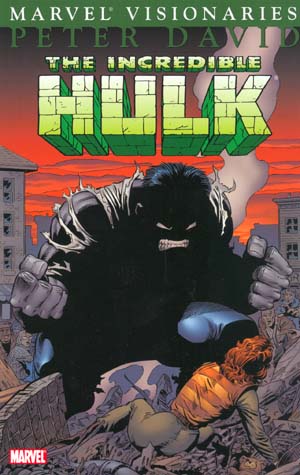
 As for the stories, they take a little while to get going, since David just jumped in following a previous writer, and didn't start a new "arc" like they do these days. I found the first volume a little pedestrian and bland, although it does feature some impressive early art from Todd McFarlane that reminds you how good he was when he actually drew comics for a living. There are a few David trademarks - most notably the issues that start with a focus on incidental characters who get caught up in the main story and then are never seen again - but things don't really get going until the later volumes.
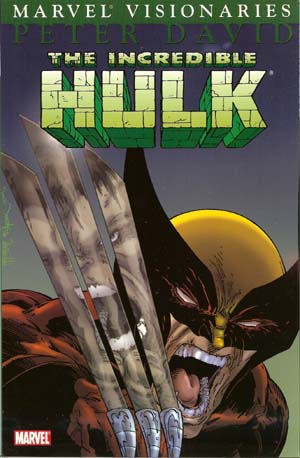 The second volume features more McFarlane art and the culmination of the storyline that pits the Hulk against the Leader in an effort to prevent a gamma bomb from destroying a small town. David really gets into the psychology he'd become known for, with Bruce Banner feeling guilty about his creations getting used for such destructive purposes. And David also lets the hero lose and the story end on a down note - the town is destroyed, and while the Hulk only appears dead, almost all the town residents actually are. Pretty grim stuff.
 The third volume deals mostly with a storyline I figured I'd really enjoy - the Hulk's time in Las Vegas as a casino security enforcer named Mr. Fixit. I was actually disappointed there wasn't more of this - David pretty quickly gets back to the superhero stuff, and takes a two-issue detour to the fantasy realm of Jarella's World, where some of his trademark political allegory shows up. The volume ends with the Hulk still in Vegas, though, so I hope there's some more of it in the next collection (which comes out at the end of November).
Volume three also demonstrates one of the difficulties of collecting stories from this era, since they were so often reliant on frequent crossovers. They have to throw in an issue of Web of Spider-Man (written, at least, by David himself) and one of Fantastic Four (written by Steve Englehart) so as not to break up the flow of the story. Thus, this volume feels a little slim and light on developments for the Hulk himself, who starts becoming more and more complex. It's got some really good art from Jeff Purves, whom I had never heard of before, and who apparently left comics after his Hulk run was over (although it looks like he did enough issues that he should fill volume four). His work is really expressive and exciting, and the way he draws the Hulk's face is really evocative and creative; he doesn't just go with the standard "Hulk smash!" grimace, but really gives you a sense of what's going on in the character's mind, which isn't easy with someone like that.
I've never been a huge fan of the Hulk as a character, so it takes a lot for me to care about his adventures, and I'm not yet bowled over by David's work. But it's great to read such a longform story and see how seeds are planted and then pay off, and how characters change and grow over time. I have no doubt that there are interesting and unexpected developments ahead, and as long as Marvel keeps putting these books out, I'll keep reading them. Now if only they would collect Spider-Man 2099, and DC would collect all of Supergirl and Young Justice.


No comments:
Post a Comment