Tuesday, August 13, 2013

Triskaidekaphilia: 'Officer Thirteen' (1932)

On the 13th of each month, I write about a movie whose title contains the number 13.

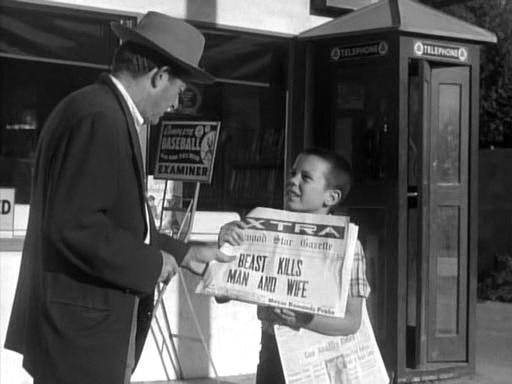
The dull, dreary morality play Officer Thirteen runs only 59 minutes, but it feels like twice that, with its slow, monotonous story about a wholesome police officer killed in a hit-and-run accident and his wholesome partner's quest for justice. Shot in the flat, static style of a lot of early talkies (albeit with some inadvertently fascinating footage of 1930s Los Angeles), Officer Thirteen starts with some lead-footed comedy about jovial police officers Tom Burke (Monte Blue) and Sandy Malone (Charles Delaney) pulling over a horrifying Italian stereotype and letting him go thanks primarily to his wacky accent, then teasing Sandy's son and his friend before very unsafely riding them to school on their motorcycles.

Things turn serious, however, when Sandy takes off in pursuit of a speeder who ends up deliberately running him off the road into a ditch. The accident doesn't look serious when it happens onscreen, but it apparently ends up being fatal, and the grief-stricken Tom takes it upon himself to avenge his partner and take care of the man's elderly mother and cute son (played by a young Mickey Rooney). This involves a lot of hectoring "crime does not pay" nonsense, culminating in a raid on a gambling joint where the killer has been holed up. The movie takes on corruption (the killer gets off because his boss, who owns the illegal casino, bribes top officials), perjury (the killer's girlfriend initially lies for him at his trial) and the twin scourges of illegal gambling and driving over the speed limit, with all of the bad guys getting their comeuppance and the heroes remaining morally pure.

Tom is so stolidly heroic that he not only achieves justice for his dead partner but also takes care of the dead man's entire family, stands up to his bosses at the police department, and almost single-handedly reforms the killer's girlfriend, Doris Dane (Lila Lee), turning her from a gangster's moll into an upstanding citizen who makes her judge father proud and an eventual surrogate mother for Sandy's mop-topped kid when she decides to marry Tom. He's such a great guy that he even manages to turn his unlucky badge number (13, of course) into a sign of good luck. The movie is similarly bland and upright, with wooden performances, stiff dialogue and turgid pacing. It's designed simply to teach the audience a lesson, but the lesson mainly is that movies like this are a terminal bore. (Watch the whole thing yourself at the Internet Archive.)

Saturday, August 10, 2013

Shark Week 3: 'Jaws 3' (1983)

If Jaws 2 was making an effort to recapture the style and tone of Steven Spielberg's groundbreaking 1975 original, along with taking advantage of the box-office appeal of shark attacks, Jaws 3 has no such concerns, going right for the sensationalistic violence with only the most tenuous connections to the characters and story of the first two movies. Although the main character is Mike Brody (Dennis Quaid), son of original protagonist Martin Brody (Roy Scheider, who supposedly booked another movie specifically so he wouldn't be available for this one), only a few throwaway lines of dialogue connect him to the character played by other actors in the previous movies, and it would make virtually no difference to get rid of the connection entirely.

The grown-up Mike is now working at SeaWorld in Florida, which has just opened a massive new attraction that mingles with the open sea (the real-life SeaWorld in Florida is landlocked, but parts of the movie were shot on the Florida coast). The underwater complex is realized via a mix of miniatures and rather shoddy-looking special effects, which are made even less convincing by the fact that the movie was shot in 3D but of course is only available to watch in 2D on home video. Like most 3D movies of the '80s, Jaws 3 is filled with random objects thrusting toward the camera, although some of them are rendered in such fake-looking special effects that they look more like objects just sort of floating in front of the screen. The unconvincing effects often undermine the suspense, which is pretty minimal to begin with anyway.

There's no effort here to connect the sharks that accidentally find their way into SeaWorld with the sharks of the previous two movies; it's just serious bad luck that Mike and his younger brother Sean (John Putch) are subject to deadly shark attacks for the third time. There's some rote, underwhelming drama about Mike's relationship with his girlfriend (Bess Armstrong), and Sean hooks up with another park employee (Lea Thompson) before being quickly jettisoned from the story altogether. The climax focuses more on eccentric park owner Calvin Bouchard, played by Louis Gossett Jr., hamming it up as a stereotypical greedy businessman.

It's sort of surprising that SeaWorld authorized the use of its brand (and its actual park) in this movie, which portrays the company as greedy, neglectful and irresponsible. Of course, SeaWorld isn't actually run by a colorful, careless millionaire, but still, I can't imagine this movie was positive PR for them. Maybe if it had been a better movie with a more interesting story, it could have showed how SeaWorld's commitment to preserving marine life could help prevent shark attacks, or something. Instead it's just a mediocre thriller that does no good for the brands of either SeaWorld or Jaws.

Friday, August 09, 2013

Shark Week 3: 'Dark Tide' (2012)

At one time, I thought John Stockwell was one of the most underrated directors in Hollywood. He boasted a fresh, glossy visual style and a simple, direct approach to characters, and he turned potentially trashy, cliched movies like Crazy/Beautiful and Blue Crush into engaging, vibrant experiences. But Stockwell followed those two movies by taking on increasingly questionable projects, from the vapid if pretty Into the Blue and the dismal horror movie Turistas down to a number of barely released obscurities and the much-maligned Nat Geo TV movie Seal Team Six: The Raid on Osama bin Laden.

Dark Tide is one of Stockwell's projects that barely made it to theaters, although given its lead performance from Halle Berry, that's somewhat surprising. Berry's star power is the only thing this movie has going for it, though, and even she doesn't exactly bring anything exciting to her role as supposed "shark whisperer" Kate Mathieson. Following a tragedy that takes the life of one of her team members, Kate gives up frolicking with sharks for good, until her slimy ex (Olivier Martinez) recruits a rich asshole who will pay big money to have Kate teach him to swim with sharks.

This sounds like the setup for your typical shark-attack thriller, but Dark Tide doesn't get to what would be the beginning of that kind of movie until its final 20 minutes, when the boat containing Kate and her crew capsizes in shark-infested waters during a storm. By that point, the movie has already spent more than 100 minutes on Kate's boring angst, her dysfunctional relationship with her ex, the rich dude's issues with his son, and other mundane, uninteresting personal drama. Stockwell, who conveyed beautiful ocean imagery in Blue Crush and Into the Blue, fails completely on the visual front here, and the underwater scenes are so murky and confusingly edited as to be almost entirely incomprehensible. For a couple who met during filming and are now married, Berry and Martinez have no chemistry, and none of the other actors can bring any life to their characters, either. In most shark-attack movies, there would at least be the satisfaction of seeing these cardboard characters entertainingly eviscerated, but Dark Tide denies its audience even that basic pleasure.

Thursday, August 08, 2013

Shark Week 3: 'Bait' (2012)

It represents some sort of failure on the part of the filmmakers that Bait is not titled Supermarket Sharks. Stupid, catchy titles have been the recipe for success when it comes to recent low-budget shark-attack movies (think Sharknado, Sharktopus, Sharks in Venice), but Bait seems to have higher ambitions. Despite the premise of the movie literally involving sharks in a supermarket, the title is instead a more generic (albeit briefly relevant), theoretically classier name for a thriller that tries to inject real drama into its silly setup. That setup involves a tsunami striking the coast of Australia, flooding a supermarket and trapping a handful of people inside. The tsunami has brought some wildlife along with it, and Bait features one shark menacing a small group inside the supermarket, while another shark menaces survivors in the underground parking garage.

A shark prowling the aisles of a grocery store is an inherently silly concept, but director Kimble Rendall and the six (!) credited screenwriters don't play it for laughs. Instead, they focus on the relationship drama among various characters in the supermarket.There's the tortured hero who once watched his best friend/the brother of his fiancee get killed by a shark, and now has lots of shark-related angst. Wouldn't you know it, his now-ex-fiancee shows up in the supermarket with her new boyfriend just before the tsunami hits. Will the new boyfriend die, clearing the way for the former lovers to reunite? Yes, of course he will.

The acting in Bait isn't that bad by B-movie standards (Nip/Tuck star Julian McMahon even has a supporting role), but the drama is pretty unconvincing. The shark attacks are marginally more effective, and while the special effects are dodgy, they are light years ahead of a lot of bargain-basement shark movies. Possibly the weirdest and most distracting thing about this movie is the way that many of the actors sort of halfway affect American accents, despite the movie clearly taking place in Australia and other characters speaking with obvious Australian accents. And it's not even like one or two characters are meant to be American -- the accents waver from scene to scene and line to line for no apparent reason. Bait actually ended up being a pretty large international hit (although not in the U.S.), so maybe the flattening of the accents paid off somehow, but it's just one more element contributing to the generic, lifeless tone of what could have been a much more fun movie.

Wednesday, August 07, 2013

Shark Week 3: '2-Headed Shark Attack' (2012)

For various reasons, I have seen several of the ultra-low-budget productions from "mockbuster" factory The Asylum, and 2-Headed Shark Attack is pretty typical of the company's work. With Carmen Electra, Charlie O'Connell and Brooke Hogan in the cast, it actually has more star power than a lot of Asylum releases, but otherwise it's the same terrible acting, incoherent writing, inept direction and shoddy special effects, with lots of padding to get to the 87-minute running time. The only real appeal of any Asylum movie is the so-bad-it's-good quality, but even that is in fairly short supply here. Most of 2-Headed Shark Attack is just tedious and boring, without anything even entertainingly awful about it.

There's plenty of non-entertaining awfulness, though. It starts with the basic premise, that a small boat full of scantily clad hotties is actually a "semester at sea" vessel for college students, manned by one ineffective professor (O'Connell), his wife (Electra) -- who is maybe a doctor? -- and a captain who seems to possess very little nautical knowledge (also, the professor is occasionally referred to as the captain, for some reason). This alleged educational expedition comes in contact with the titular creature, ending up stranded in the middle of the ocean next to a small atoll, to which everyone evacuates for reasons that aren't entirely clear.

Also not entirely clear: Why does the shark have two heads? There's some vague handwaving about mutants or something, but the movie doesn't even bother to come up with some ludicrous explanation. The shark has two heads because it does (and, as one character astutely notes, two heads means twice the teeth). The movie consists of the college students running around randomly, the females in bikinis (and sometimes gratuitously topless), the males in board shorts and tank tops, broken up by occasional perfunctory shark attacks (this movie has some of the least convincing screaming I've ever heard onscreen). The editing is so terrible that there's often a complete lack of continuity between shots of the animatronic shark heads and the CGI shark, within the same attack scene.

Director Christopher Douglas-Olen Ray is the son of legendary schlockmeister Fred Olen Ray, so in a way he's just carrying on the family tradition (his other movies include Reptisaurus, Mega Shark vs. Crocosaurus and Asylum mockbuster Almighty Thor). He certainly isn't aspiring any higher than his father's example, and 2-Headed Shark Attack is indifferently directed at best. Even for a movie with such a tiny budget, it's sloppy and half-assed; witness the pathetic swaying of the actors when their boat is supposedly being battered or the atoll is supposedly trembling and collapsing. Or the many background goofs, including a visible dinghy in the supposed middle of the ocean, and an actor clearly cracking up at one point after Hogan slaps another character in the face. When the people who made the movie barely seem to care about it, it's hard to muster up even ironic enthusiasm for the viewing experience.

Tuesday, August 06, 2013

Shark Week 3: 'Shark Night' (2011)

Stunt coordinator turned director David R. Ellis had just started garnering a following as a creator of entertaining, unpretentious B-movies when he passed away unexpectedly earlier this year, and it's unfortunate that Shark Night stands as his final film. Not that he was some secretly brilliant filmmaker -- his other movies include Snakes on a Plane, Cellular and the second and fourth installments of the Final Destination series -- but his name was a semi-reliable indicator of something a little more clever than the average brain-dead horror or action movie.

Shark Night doesn't quite live up to the standards of some of Ellis' previous work, although it was more enjoyable to watch than I had expected based on the terrible reviews. It basically takes the slasher-movie template and applies it to a shark movie, with a group of attractive college students taking a trip to a secluded lake house, where they get picked off one by one. Yes, the lake is full of sharks, but the movie's real villains are human beings, the kind of devious backwoods psychopaths familiar from any number of formulaic horror movies. The sharks are essentially the killers' weapons; they're the equivalent of Jason Voorhees' machete or Freddy Krueger's claw glove.

Shark Night is held back by its PG-13 rating, preventing it from including slasher-movie staples like gratuitous nudity or copious gore, but Ellis still manages to stage some creative death scenes (and he somewhat refreshingly reserves his only nudity for the backside of one of the male characters early in the movie). Donal Logue and Joshua Leonard make for amusingly sinister hicks, and the main cast of young, pretty people is at least competent. I realize that's all faint praise, and the biggest problem with Shark Night is that it completely lacks scares or suspense. The villains spend a lot of time describing the specific species of sharks that they've put in the lake, but then the CGI animals are completely unrealistic giant monsters. The movie fares better with humor (it even includes an explicit reference to shark week), but it's not quite funny enough for full-on camp. As with most of Ellis' work, it's better than it probably needed to be, but that doesn't exactly mean that it's good. If he'd been able to stick around longer, though, I bet Ellis would have gotten there eventually.

Monday, August 05, 2013

Shark Week 3: 'The Reef' (2010)

Not to be confused with the 2006 animated movie of the same name (which also features sharks), The Reef is an Australian thriller based very loosely on a true story, about five friends whose yacht capsizes after hitting the titular object, stranding them in waters infested with great white sharks. Four of the friends decide to attempt to swim to a small island several miles away, while the fifth crew member stays behind on the overturned boat. The swimmers are constantly on edge as they look out for sharks, and although it takes until more than halfway through the movie, eventually the sharks deliver.

The Reef is a lot more serious than your average low-budget shark-attack movie, and was actually pretty well-reviewed upon its release. Writer-director Andrew Traucki does a decent job of building suspense before the shark attacks start, but once the first shark chomps into one of the characters, the movie loses momentum, since we're just sitting around waiting for the inevitable next attack. Comparisons have been drawn to Open Water, but while that movie waited until the very end to show any real violence, The Reef has several pretty gory shark-attack scenes. They may be impressively staged, but they also turn the movie from a low-key suspense story into a full-on horror movie.

The characters are thinly sketched to begin with, but the dialogue really deteriorates once the shark attacks are in full effect, and the actors (especially Zoe Naylor) really overdo it on the hysteria. The Reef is certainly a cut above the majority of shark-attack B-movies, and it compares favorably with Open Water, but those aren't the highest bars to clear.

Sunday, August 04, 2013

Shark Week 3: 'Snow Shark: Ancient Snow Beast' (2012)

There have been so many low-budget shark attack movies that it's become increasingly hard for filmmakers to find a new angle to set their story apart. That leads to things like Sharktopus and Sam Qualiana's Snow Shark: Ancient Snow Beast, which I saw at last year's PollyGrind film festival. It's your basic micro-budget horror movie, with plenty of camp, questionable acting, dicey special effects and more enthusiasm than craft. But it's occasionally entertaining thanks primarily to the amusingly moronic premise, that some sort of prehistoric shark is lurking in the snow around a small town after having been released from an underground lake.

Never mind that the snow is unlikely to be deep enough to conceal an entire shark, or that the shark lurks undetected for years despite, presumably, snow melting every spring. It's just an excuse to see a shark fin darting through the snow and to have a gruesome, bloody death every few minutes. Qualiana throws in the standard gratuitous nudity and occasional snark, but it's kind of half-hearted, and the movie has a tough time settling on a main character (since everyone keeps getting devoured by the snow shark). The extremely low budget obviously limits what Qualiana can do with the snow shark, and he wisely keeps the glimpses to the minimum required to get the premise across.

The biggest resource a movie this small-scale has is its own cleverness, but Qualiana's script isn't nearly as funny or sharp as the movie's early Jaws-parody poster. There are funny lines here and there, but the delivery is often so stilted that they fall completely flat. And Qualiana doesn't always know how to maximize his limited resources; scenes like a town-hall meeting with obvious piped-in "crowd noise" are distracting in their ineptitude. Still, fans of dumb low-budget monster movies may get a bit of entertainment out of Snow Shark, although they can probably get the same amount out of just looking at that poster.

Shark Week 3: This Time It's Personal

According to The Hollywood Reporter, shark movies are big business right now. In the five years since I first put together a week's worth of posts about shark movies in honor of Discovery Channel's mega-popular Shark Week, the market for low-budget shark-attack thrillers has greatly expanded. At the time I first came up with this idea, I figured that there wouldn't be enough interesting shark-related movies to sustain more than one week. Then two years ago, I did another week. And now there are so many shark movies being churned out that I probably could have expanded this project to an entire Shark Month.

The success of Sharknado has certainly fueled interest in cheesy shark movies, and I am here to cater to that interest. Unlike past Shark Weeks, this year's edition will feature almost exclusively recent movies, although it will of course culminate with the third Jaws movie, in keeping with my established tradition. Starting later today and for the next seven days, I'll be writing about movies that feature sharks attacking in a supermarket, a water park, the snow, a lake and the boring old ocean (I will not, however, be writing about Sharknado, because the last thing that movie needs right now is more coverage). Until then, here are the posts from the last two Shark Weeks:

Shark (1969)
She Gods of Shark Reef (1958)
Deep Blue Sea (1999)
Spring Break Shark Attack (2005)
Dark Waters (1993)
Open Water (2003)
Jaws (1975)
The Deep (1977)
Shark Attack 3: Megalodon (2002)
Tintorera: Killer Shark (1977)
Beyond the Reef (1981)
Sharktopus (2010)
The Adventures of Sharkboy and Lavagirl (2005)
Jaws 2 (1978)

Saturday, July 13, 2013

Triskaidekaphilia: 'Apollo 13' (1995)

On the 13th of each month, I write about a movie whose title contains the number 13.

Ron Howard's penchant for crowd-pleasing inspiration finds its ideal subject matter in Apollo 13, which is cheesy at times but also admirably authentic, with a commitment to historical accuracy that nicely balances the sentiment. Howard meticulously re-created details of the ill-fated 1970 Apollo 13 mission to the moon, using transcripts from the control room to construct the dialogue, and eschewing all stock footage of rocket launches in favor of constructing his own images via miniatures, CGI and practical sets. He even shot some zero-gravity scenes during actual zero-gravity training flights, which offer only 23 seconds of weightlessness each in which to capture footage.

So even though the story arc is pure Hollywood corn, and the characters come off like movie archetypes, Apollo 13 feels genuine, and that makes it easier to cheer for the three all-American astronauts when they avoid disaster and safely return home. Tom Hanks is of course perfectly cast as the honorable, friendly and ultra-competent Jim Lovell, and Bill Paxton and Kevin Bacon do well as his two crewmates. The acting in Apollo 13 is best when it's all about the characters getting things done; Ed Harris has only a few tiny moments of emotion as the no-nonsense mission control commander, but he earns his Best Supporting Actor Oscar nomination.

It's not easy to generate suspense in a movie based on a true story, when the audience already knows the outcome, but Howard manages to do just that when the Apollo 13 astronauts encounter mechanical trouble and have to turn back for home, unsure if their vessel will make it. The movie spends a little too much time on setup, and the soaring triumph at the end is a little overdone (at 140 minutes, the movie is the typical length for Oscar bait, but does feel too long), but overall it's involving, entertaining and genuinely uplifting. It's exactly the kind of slickly produced populist entertainment that Hollywood is made for.

Wednesday, July 10, 2013

'Camp'

A wholesome family dramedy full of attractive young actors, Camp seems like it would probably be more at home on ABC Family than on NBC. It also makes me miss Huge, the sadly short-lived ABC Family dramedy about a weight-loss summer camp for teens. Like Camp, Huge featured plenty of familiar elements of summer camp movies, but it also showcased the kind of characters rarely seen on TV, and it did so with nuance, compassion and impressive acting. The summer camp on Camp is more standard-issue, although it is a "family camp," meaning that kids, teens and their parents all stay together in cabins and participate in outdoor activities, which is something I'm not familiar with.

Even so, the first two episodes feature a series of stock summer-camp elements, including the talent show, the capture-the-flag game, the snooty rival camp and the summertime-only romances. The cast is appealing, led by Rachel Griffiths as the somewhat neurotic camp owner/director, who's in the process of getting a divorce. The large ensemble means that the characters are a little one-dimensional at this point, with fairly simplistic conflicts, but there are hints of complexity that could develop into something over time. For the most part, Camp is pretty basic and predictable, but if you (like me) have a soft spot for heartfelt teen/family dramas, it could be worth watching, if only to spend time with some likeable, easygoing characters.

Premieres tonight at 10 p.m. on NBC.

Monday, July 01, 2013

'Siberia'

Anyone unfamiliar with the premise of NBC's Siberia would be forgiven for turning off the first episode halfway through, mistaking it for another second-rate summer reality show, a derivative take on elements of Survivor and The Amazing Race. But Siberia isn't a second-rate reality show; it isn't a reality show at all, but rather a scripted drama presented in the style of a reality show, in which terrible things start happening on a familiar-looking survival competition series (featuring 16 contestants dropped in the titular location and forced to fend for themselves).

Those terrible things don't really show up until the end of the first episode, which is why less informed viewers might just assume that Siberia is a typical reality show. Creator Matthew Arnold, who wrote and directed the pilot, does a fantastic job of mimicking the style and tone of reality shows, from the time-lapse shots of the outdoors to the talking-head interviews to the pompous host. He copies the style so well that the episode actually gets a little tedious, especially if you know that nasty things are in store for the "contestants" (played by actors all using their real first names), and are waiting for them to show up.

It's hard to tell from this first episode how well Siberia will play out over the course of a whole season. Although its style may copy Survivor, the show that Siberia most closely resembles is ABC's The River, which was also presented like a reality show (albeit a nature-exploration show, not a survival competition). The River started with a very promising pilot before quickly painting itself into a corner, and Siberia could run into the same problems. In particular, I wonder if the reality-TV style will extend throughout the entire season; under attack from mysterious forces, will the contestants continue giving explanatory interviews, and will the cameramen continue dutifully shooting everything? For now, at least, I'm interested enough to find out.

Premieres tonight at 10 p.m. on NBC.

Thursday, June 13, 2013

Triskaidekaphilia: '13 Lead Soldiers' (1948)

On the 13th of each month, I write about a movie whose title contains the number 13.

Bulldog Drummond is a sort of second-rate Sherlock Holmes, created in 1920 by author Herman Cyril McNeile under the pen name Sapper. He starred in 17 novels from 1920-1954, as well as 26 movies from 1922-1969, played by 15 different actors. According to Wikipedia, he was an important influence on later pulp characters, as well as on James Bond, but he seems pretty much unknown today (although he may be more popular in the U.K., where the novels originated). 13 Lead Soldiers is one of the later Drummond films, and the second of two to star Tom Conway as the main character. It's a pretty rudimentary murder mystery, with a running time of just 64 minutes and a limited number of characters.

The lead soldiers of the title are antiques from the era of William the Conqueror, two of which are stolen when their owner is murdered at the beginning of the movie. Drummond, a wealthy war veteran and armchair detective, is enlisted by the owner of two more soldiers to find out who is behind the murder. The eventual reveal involves hidden treasure and secret passageways, but it's all treated as very mundane, and Drummond and his sidekick Algy Longworth (John Newland) never get particularly worked up about the crime-solving or the danger they're potentially in.

They spend far more energy competing to seduce the women they're interrogating and/or protecting, and a running subplot in the movie involves Longworth pretending to be Drummond because he believes it will help him score with the ladies. The condescending sexism pervades the movie, but apparently it's mild compared to the racist and xenophobic attitudes Drummond expressed in many of McNeile's novels (maybe that's why he's no longer appreciated). As a murder mystery, 13 Lead Soldiers is rote and mediocre, although Conway has a bit of debonair charm as Drummond (who was apparently more of a thug in other portrayals). As a forgotten piece of pop-culture history, however, it can be fascinating. (Watch the whole thing for yourself on YouTube.)

Tuesday, June 11, 2013

'Twisted'

ABC Family's original dramas seem to have two basic modes: Wholesome family-driven shows like Switched at Birth and the recent The Fosters, and superficially "dark" teen dramas like Pretty Little Liars and The Lying Game. Twisted falls in the latter category, with its ominous murder mystery and pouty, tortured teens. It's all completely sanitized and safe, despite the dead teenage girl who shows up in the premiere (and whose murder presumably forms the main plot thread of the season). There's another offscreen death at the beginning of the episode, as 11-year-old Danny (Avan Jogia) kills his aunt for mysterious reasons. Five years later, he's out of prison and attempting to restart his life by returning to his close-knit hometown and attending high school with his former best friends Jo (Maddie Hasson) and Lacey (Kylie Bunbury).

Danny looks way too much like a model to have spent the past five years in juvenile detention, and in general the show's "menace" is pretty laughable. The rest of it is generic teen-soap nonsense, enlivened slightly by Hasson's appealing performance as the too-pretty high school "outcast" and Denise Richards' basically reprising her role from the modern classic Wild Things as Danny's bitchy, self-centered mother. The banter is half-baked (although the show does its best to coin "socio" as a new slang term, referring to Danny's possible sociopathic nature) and the characters are mostly one-dimensional. Fans of Pretty Little Liars and The Lying Game may find some entertainment here, but all I really want from ABC Family is another season of Bunheads.

Premieres tonight at 9 p.m. on ABC Family.

Thursday, June 06, 2013

'The Hero'

I like The Rock, but man is he phoning it in as the host of TNT's muddled Survivor/Fear Factor/The Mole hybrid The Hero. About half of his hosting segments just involve him talking in front of a green-screened backdrop in the same style as the contestant confessionals, and he's not even present for all of the big physical challenges in the first episode. He may be one of the show's producers, but the whole thing seems sort of beneath him, since he's a legitimate movie star at this point. He's also pretty much the only entertaining aspect of this show, which has a weak premise and a cast full of reality-TV stereotypes.

I'm pretty sure that signing up for a TNT reality show automatically disqualifies a person from being a hero, but the idea here is that the nine contestants are competing for some nebulous title of "hero," which is defined partly by completing intense physical challenges that involve facing fears, partly by resisting and/or giving in to temptation when faced with offers of compensation in exchange for screwing over fellow contestants, and partly by some undefinable quality that will be judged by the audience, who ultimately get to vote for the winner. In practice this means some standard-issue reality-competition set pieces (rappelling off the side of a building, crawling through a maze in the dark) and even more standard-issue reality-TV bickering, which is about as far from heroic as it gets.

The Rock does his best to play up the idea that this all has something to do with heroism, and his most amusing habit is constantly addressing the audience as "America" ("Hola, America" is the first line of the show). Despite higher production values than some cable reality shows, and impressive-looking locations in Panama, The Hero is not nearly as exciting as The Rock pretends to think it is.

Premieres tonight at 8 p.m. on TNT.

Wednesday, May 29, 2013

Bette Davis Month Bonus: 'The Cabin in the Cotton' (1932)

The Cabin in the Cotton opens with an overwrought disclaimer describing the historical conflict between plantation owners and sharecroppers in the American South, and assuring moviegoers that the producers of the film have no desire to take sides. That dull evenhandedness infuses the rest of the film, which works hard to portray the disagreements between the rich landlords and their indentured workers as something to be solved with minor compromise, rather than as a system built on inequality and prejudice.

Not that the filmmakers have an obligation to present a detailed political critique within the context of what is essentially a B-level melodrama, but the movie spends so much time foregrounding the social commentary that it would be nice if it were less laughable. A big part of the problem is leading man Richard Barthelmess, a silent-era star who didn't have much of a career once sound came in. He looks sallow and lifeless as sharecropper's son Marvin Blake, who ends up caught between working for the rich plantation owner and helping his friends and relatives who work the fields. There's a weird undercurrent of anti-intellectualism to the story as well, since Marvin's ambitions to succeed in school are what take him away from his roots into the corrupt world of the upper class, and he's relentlessly mocked for his book-learnin' by the people he grew up with.

He's also torn between the wholesome but boring girl next door (literally) and Madge, the sexually aggressive daughter of the plantation owner. Naturally, Bette Davis' performance as Madge is the best thing in the movie, and she's excellent at playing the sultry, snobby rich bitch. She shamelessly throws herself at Marvin, using her feminine wiles to manipulate him into betraying his class, and then snubbing him when he speaks up in favor of the poor. Davis' performance is playful and seductive, and features one of her all-time greatest (and most quoted) lines: "I'd like to kiss you, but I just washed my hair." As great as Davis is, however, she and Barthelmess have no chemistry, since he plays his entire part like he's suffering from mild indigestion (including his big speech at the end). Still, the movie is a great example of how Davis could shine in even the dreariest material.

Monday, May 13, 2013

Triskaidekaphilia: 'Thirteen Ghosts' (2001)

On the 13th of each month, I write about a movie whose title contains the number 13.

The 2001 remake of William Castle's 1960 schlock-horror classic 13 Ghosts (which I wrote about a year ago) was part of a short-lived initiative to revive Castle properties as modern horror B-movies (it followed a 1999 remake of House on Haunted Hill), but it takes only the barest elements from the original movie, changing a hokey family ghost story into a loud, R-rated killing spree. Plot-wise, there's still a down-on-their-luck family inheriting a creepy house from their deceased uncle, and the house is still filled with the titular ghosts (only 12, as the 13th is slated to be one of the family members), but the approach is completely different.

While the ghosts in the original turned out to be sort of harmless, here they are bloodthirsty and deadly, and once the family members end up inside the house, they're almost immediately hunted by the murderous apparitions. The house itself is the movie's most impressive element; it's a marvel of production design, a shifting puzzle box of glass and metal gears that one character reveals is "a machine designed by the devil and powered by the dead." Nearly the entire movie takes place in this one location, over the course of a single night, and director Steve Beck (a special-effects veteran making his directorial debut) creates a claustrophobic atmosphere as the characters run back and forth between corridors and locked rooms.

The characters themselves, however, are pretty one-dimensional, and the plot is full of so much mystical mumbo jumbo that it ends up being total nonsense. The ghosts, although certainly gorier than those in the original, aren't very scary, and the incoherent plotting takes away much of the potential suspense. The cast is a mix of talented actors slumming for a paycheck (Tony Shalhoub, F. Murray Abraham, Embeth Davidtz) and C-level performers you'd expect to see in a movie like this (Matthew Lillard, Shannon Elizabeth, rapper Rah Digga), but everyone ends up on the same mediocre level.

They're really just pieces to move around the elaborate set and react to the less impressive special effects. The filmmakers recycle one of Castle's gimmicks by updating the idea of special glasses being used to see the ghosts, but since the movie wasn't ever shown in 3D, the point is kind of lost. As schlocky as Castle's work was, at least it had a personal touch; this version is merely a product trading on vague name recognition.

Saturday, April 13, 2013

Triskaidekaphilia: 'Lucky 13' (2005)

On the 13th of each month, I write about a movie whose title contains the number 13.
 
Shot somewhere around 1999 but not released until 2005, Lucky 13 probably only found distribution after such a long time thanks to co-star Lauren Graham's Gilmore Girls fame. It certainly doesn't deserve attention for anything else -- not its lame, half-assed story, weak dialogue, annoying characters or unfunny jokes. And certainly not for charisma-free leading man Brad Hunt, whose performance is so smarmy that I initially assumed he must be the writer and director as well, putting together a vanity project about how attractive and charming he is.

But no, Hunt is just the crappy actor hired by actual director Chris Hall to play 20-something loser Zach, who's spent his entire life pining away for his neighbor Abbey (Graham). When Abbey announces she is moving to New York City to become an artist, Zach finally asks her out on a date, and he has just a few days to make himself the perfect boyfriend material for Abbey. Thus he decides to revisit all 12 of his past girlfriends to learn why he could never hold onto a relationship.

This is a pretty standard contrived rom-com setup, but Hall and his co-writers completely screw it up with terrible pacing, lame jokes and barely sketched characters, including all of Zach's exes, many of whom barely even get any lines. Only a couple of his exes actually serve their ostensible plot purpose and give him some advice; otherwise they just show up for bad jokes or as background filler. I'm not entirely sure there are even 12 of them.

In addition to Graham, Lucky 13 is full of soon-to-be-famous faces, including Kaley Cuoco, Jenna Fischer, Taryn Manning, Ever Carradine, Pamela Adlon and Sasha Alexander (also a producer on this mess). There's also Harland Williams in a surprisingly subdued performance as Zach's goofy best friend, plus X's John Doe and That '70s Show's Debra Jo Rupp as his parents. The movie isn't worthy of any of their talents.

Friday, April 05, 2013

Bette Davis Month Bonus: 'The Golden Arrow' (1936)

Alfred E. Green directed Bette Davis in a number of her early films, including the 1932 hidden gem The Rich Are Always With Us. Green's The Golden Arrow isn't as entertaining as The Rich Are Always With Us, but it has a similar cheeky tone and playful attitude toward the quirks of the idle rich. Davis stars as what at first appears to be the heiress to a cosmetics fortune, a spoiled young woman who spends all her time lounging about on her yacht off the coast of Florida and entertaining various suitors. But Davis' Daisy is actually an actress hired to pretend to be a cosmetics heiress, in order to drum up publicity for the company.

This particular bit of information doesn't come to light until about halfway through the movie, after which Daisy has already proposed marriage to humble newspaper reporter Johnny Jones (perpetual Davis co-star George Brent), as a mutual business arrangement so he has leisure time to write his novel and she can fend off the advances of her persistent suitors. Except he still thinks she's a real heiress, and her bosses at the cosmetics company don't want her getting married at all. Got that? It's a convoluted setup that gets even more ridiculous as the movie goes on, but Green plays it all as light farce, and Davis has loads of fun as the street-smart dame who's infiltrated high society.

The ending involves a set piece built around some uncomfortable domestic violence humor, and the story kind of runs out of steam by that point anyway. But Davis and Brent have decent chemistry (although Brent is, as always, sort of bland by comparison), and the bits of sly commentary about the indulgences of the rich are entertaining and sharply delivered. It's rare to find a gem among these generic programmers that Davis made early in her career, so even though The Golden Arrow has its flaws, it still qualifies as a pleasant surprise.

Monday, April 01, 2013

White Elephant Blogathon: 'The Beast of Yucca Flats' (1961)

Sadly, last year I missed out on the White Elephant Blogathon, in which bloggers submit movie suggestions to a pool and then write about a randomly chosen selection from another blogger, but I'm back on board this year. The first year I participated, I got something boring (Dr. Dolittle: Million Dollar Mutts), and the second year, I got something terrible (Scorpion Thunderbolt), and this year I got a movie that's both boring and terrible, Coleman Francis' The Beast of Yucca Flats.

Although Beast is probably best known for its appearance in an episode of Mystery Science Theater 3000, I did not cheat -- I watched the original film without any comedic commentary, although I did check out some MST3K clips online. And boy is this a movie that needs comedic commentary to liven things up. It's only 54 minutes long, but it feels like a lifetime, with maybe 10 minutes of plot crammed into endless scenes of cars driving and parking (seems Francis must have been a big influence on Birdemic's James Nguyen), all narrated semi-coherently by Francis himself, since there was no sound recorded during production.

That means that either Francis is narrating in his rambling, ponderous style (sometimes filling in plot and character details, sometimes waxing poetic about nuclear armageddon), or he's throwing in awkwardly dubbed dialogue that can only be delivered when characters are offscreen or have their faces obscured in some way (since none of the words match up to the movement of the actors' mouths). It's possible to achieve a sort of otherworldly effect this way, and the movie's opening scene (which seems to have no connection to the rest of the story), in which a nearly naked woman is strangled by an unseen brute as a clock ticks loudly, is actually pretty creepy.

But the rest of the movie is just moronic, with a Soviet scientist played by Ed Wood favorite Tor Johnson getting caught up in a nuclear blast and transformed into the beast of the title. Mostly that means he lumbers around the sparse landscape, occasionally listlessly choking some anonymous passerby. Francis fails at creating suspense or even shocks; Johnson looks less like a beast and more like a guy with a bad sunburn. He clumsily stalks incompetent cops and an annoying family on vacation, but none of the performances have enough energy to make the threat seem urgent or even particularly dangerous. When the beast is defeated, it's the final anticlimax in a movie that's just one long disappointment.

Kenji Fujishima wrote a fascinating post on my pick, Cannibal Women in the Avocado Jungle of Death, which I definitely need to revisit.